About Delphinium geyeri Greene
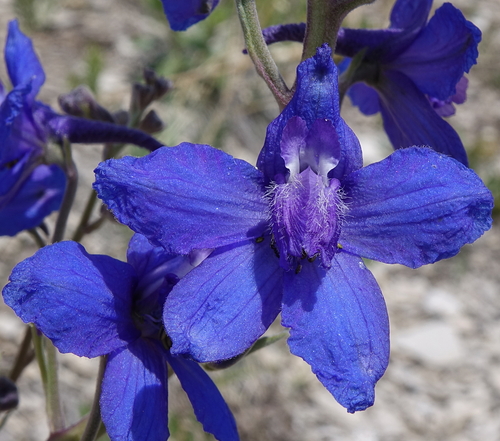
Delphinium geyeri Greene is a medium-sized herbaceous plant. When flowering, it most often grows 30 to 60 centimeters (12 to 24 inches) tall, though it may occasionally reach 80 centimeters (31 inches) or be stunted to just 15 centimeters (5.9 inches). The base of its flowering stem is usually reddish and covered in fine hairs (puberulent), and unlike monkshood (Aconitum) stems, its stems are not hollow. Leaf placement is variable: plants may or may not retain basal leaves when flowering, and they typically grow 4–22 leaves on their flowering stem. The plant develops several thick, tuberous and fibrous roots that grow downward from its crown. The leaves of Delphinium geyeri are roughly round in overall shape, but deeply divided into 7–20 pointed lobes 1–6 centimeters (0.39–2.4 inches) wide. End lobes measure 2–5 mm wide on basal leaves and 2–4 mm wide on flowering stem leaves. Like the stem, leaves are covered in fine hairs and are light green in color. The similarly divided leaves of geraniums such as Geranium caespitosum are sometimes mistaken for D. geyeri leaves, but geranium leaves have much shallower divisions and greater total leaf area. D. geyeri produces leaves earlier in the growing season than many other plants in its native habitat, and its narrower, more numerous leaf divisions distinguish it from other western tall larkspurs. Each inflorescence holds 6 to 60 flowers, most often no more than 30. The flowers have bright blue sepals covered in very fine hairs; lateral sepals spread 10–18 mm and are 4–8 mm wide. The spurs at the rear of the flowers are 11–16 mm long. The folded central structure of the flower is covered in dense hairs and colored white to light yellow. Exposed stamens are 4–8 mm long. Flowering occurs from May to July. The four true petals are smaller and less noticeable than the much larger sepals. Fruits are capsules 11–15 mm long, 3 to 3.5 times as long as they are wide, and like other plant parts are covered in sparse fine hairs. The small seeds do not have a coating.
Delphinium geyeri has a limited distribution, and has only been consistently reported growing in four western U.S. states: Colorado, Nebraska, Utah, and Wyoming. In Colorado, it is recorded from four Front Range and plains counties (Jefferson, Boulder, Larimer, and Weld) plus three western counties (Jackson, Grand, and Moffat). In Wyoming, it is widely distributed across most of the state. In Utah, it grows in four northeastern counties: Summit, Daggett, Duchesne, and Uintah. No county-level distribution records exist for Nebraska. It may also grow in Montana, but its presence there is unconfirmed. It grows at elevations between 1,400 metres (4,600 ft) and 3,000 metres (9,800 ft), and is a common species in rocky hillsides, sandy areas, shortgrass prairie, mountain brush, and sagebrush-covered slopes within its range. In 1988, NatureServe evaluated Delphinium geyeri as globally secure (G5). At the state level, it has not been evaluated in Colorado, ranked critically imperiled (S1) in Nebraska, imperiled (S2) in Utah, and apparently secure (S4) in Wyoming.
The butterflies Papilio zelicaon (Anise Swallowtail) and Erynnis telemachus (Rocky Mountain Duskywing) visit the flowers of Delphinium geyeri. Herbivorous insects such as the common grasshopper Melanoplus sanguinipes rarely feed on it, due to the alkaloids in its foliage. Delphinium geyeri is a poisonous plant, and its toxicity varies from year to year, and also varies across the growing season: the plant is most toxic before it flowers. This toxic property has been recognized since at least 1916. The primary toxic compounds are browniine, 14-acetylbrowniine, geyerine, and 14-dehydrobrowniine. The plant also contains moderate amounts of delcosine and delphatine, plus minor amounts of dictyocarpine, geyeridine, geyerinine, and glaucenine. Alkaloid levels in D. geyeri are often above 15 milligrams per tenth gram of plant material, and concentrations above 3 milligrams are considered dangerous. These alkaloids act on the neuromuscular junction, causing muscle weakness and paralysis. While highly toxic to both humans and cattle, sheep are resistant to the plant's poison, and ranchers sometimes graze sheep in areas with Delphinium geyeri as a form of biological control. Horses are also less affected by the plant's poisons. For ranchers who graze cattle in areas where D. geyeri grows, average annual cattle losses are 5%, ranging from 2% low to 15% high. Delphinium geyeri is particularly problematic for cattle because it sprouts early in the spring, before many other plants produce new growth. Symptoms of Delphinium poisoning in cattle include muscle weakness, trembling, rapid heart rate, loss of voluntary coordination, respiratory failure, and death. Most research on Delphinium geyeri focuses on cattle poisoning. Just two years after its formal scientific description in 1894, Aven Nelson wrote that it is "frequently greedily eaten by hungry cattle with fatal results, caused by bloating". Research on this topic continues into the 21st century, with articles such as "Plains Larkspur (Delphinium geyeri) Grazing by Cattle in Wyoming" and "Toxic Alkaloid Concentrations in Delphinium Nuttallianum, Delphinium Andersonii, and Delphinium Geyeri in the Intermountain Region" being representative examples.
Wildflower author Claude A. Barr described plains larkspur as "arresting in the intensity and depth of its textured blueness". In cultivation, it has good drought resistance, but requires adequate moisture and suitable soil to produce maximum bloom. It is on the City of Fort Collins' recommended plant list for its very low water usage and its value as a nectar source for insects. Despite this, plants have limited availability in the horticultural trade. When planted outdoors in fall, seed germination rate is 57%, but this drops to only 5% if seeds are not cold stratified. Plants can be transplanted successfully; like many species, transplant success is highest when done while plants are small, dormant, and moved with plenty of soil surrounding the roots. Plains larkspur is winter hardy in USDA zone 4, which has a minimum temperature of about −34 °C (−29 °F). Plains larkspur seeds were offered for sale as early as 1916, and were sold regularly through the 1930s by Rockmont Nursery.