About Delilia biflora (L.) Kuntze
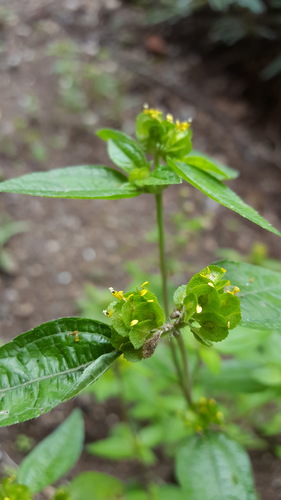
Delilia biflora (L.) Kuntze has a unique combination of floral traits. Each flower head contains one flat, petal-like ray floret that lacks stamens, plus 1 to 4 fertile disc florets with cylindrical corollas that have both stamens and female reproductive parts. Both floret types produce fruit. The flat ray floret is approximately 0.4 mm (about 1⁄64 inch) long, while the cylindrical corolla of each disc floret measures 1.3 mm (about 1⁄20 inch) long. Each fruit fuses with the 3 lowest, flatly compressed involucral bracts of its flower head to form a thin, wafer-like structure around 5 mm (about ⅕ inch) across. Flowers are arranged in roughly spherical clusters that grow both at the tips of stems and from the axils of leaves. Vegetative characteristics of this species are less distinctive. Delilia biflora is an annual much-branched herb that can reach up to 90 cm (nearly 3 feet) tall. Plants range from nearly hairless to covered with stiff, sharp, straight appressed trichomes (hairs) up to 0.5 mm (about 1⁄64 inch) long that point toward the stem tip. Leaves are simple, not deeply lobed, and grow opposite one another on the stem. Delilia biflora is native from Mexico south through Central America into South America, reaching as far as northern Argentina and Brazil. It has also been introduced to Cape Verde, Cuba, and the Galápagos. In Mexico, Central America, and the Andes of South America, Delilia biflora grows in forest understories, though it often occurs in sunny open areas at higher elevations. In Brazil, it is typically found as a weed in cultivated fields. In central highland Mexico, it has been described as apparently preferring calcareous soils and basaltic slopes, in zones of tropical deciduous forest and subtropical scrub.