About Deinandra minthornii (Jeps.) B.G.Baldwin
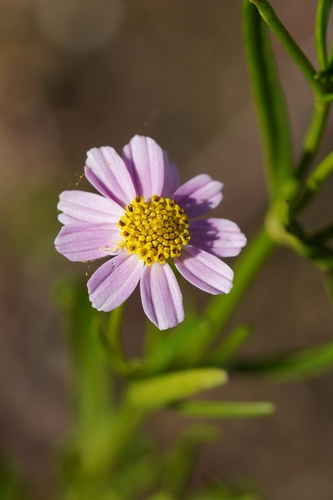
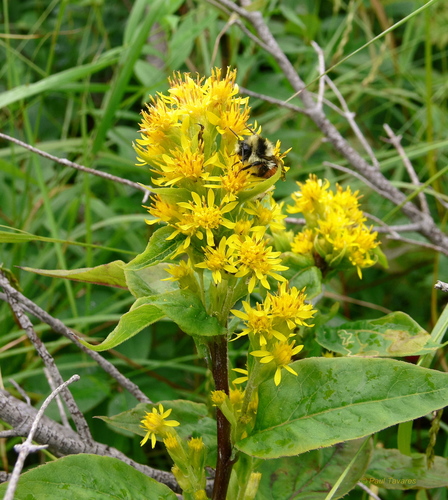
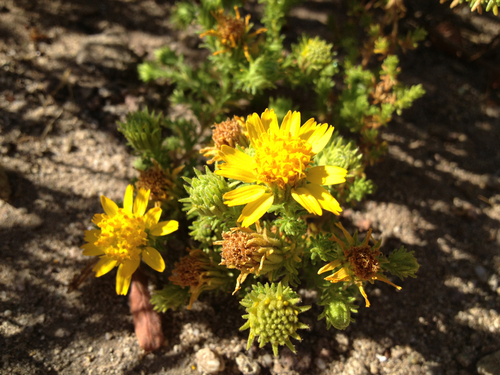
Deinandra minthornii is a shrub or subshrub that grows between 15 centimetres (5.9 inches) and 1 metre (3.3 feet) tall. Its stems mostly emerge from the base of the plant, are covered in fine hairs to short bristles, have tiny glands, and are densely leafy. Its leaves are often deciduous, with thick, linear blades 2–3 centimetres (0.79–1.18 inches) long. Lower leaves are pinnately lobed or toothed; leaves are covered in short coarse hairs, and sometimes have stalked glands. The inflorescence is made up of individual flower heads arranged in loose, raceme-shaped to panicle-shaped clusters. Bracts grow beneath each flower head, and usually cover none or half of the involucre. The phyllaries that line the flower heads are uniformly covered in stalked glands, and often also have some glandless hairs with slender, non-pustular bases. Paleae grow beneath most or all of the disk flowers. Flower heads hold 4 to 8 ray florets, each with a deep yellow corolla or lamina 5.5–6.5 millimetres (0.22–0.26 inches) long. Inside the flower heads are 18 to 23 disc florets 1–3 millimetres (0.039–0.118 inches) long, which are completely or mostly functionally staminate, with yellow or brownish anthers. There are 8 to 12 linear to lance-linear pappi 1–3 millimetres (0.039–0.118 inches) long, with scales that range from smooth-edged to fringed. Fruits are 2.5–3 millimetres (0.098–0.118 inches) long and have a short beak. This plant flowers from June to November. D. minthornii is endemic to the region stretching from the Santa Susana Mountains, through the Simi Hills, to the Santa Monica Mountains of the southwestern Transverse Ranges, located in Los Angeles and Ventura Counties, Southern California. It grows in coastal sage scrub and chaparral habitats within coastal sage and chaparral ecoregions, as well as in chaparral habitat of adjacent inland montane chaparral and woodlands. It can be found growing on rocky outcroppings and in sandstone crevices, at elevations between 300 and 500 metres (980–1,640 feet). There are about 20 known occurrences of this plant, but several have not been observed recently. Pollinators are required for this plant to reproduce, as it cannot self-pollinate.