About Deinandra fasciculata (DC.) Greene
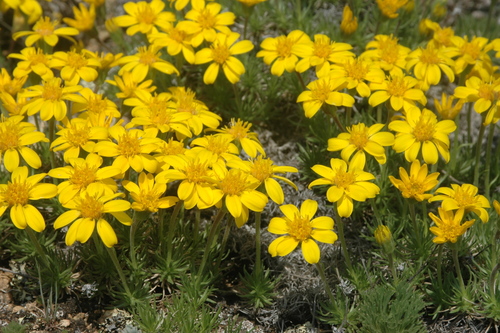
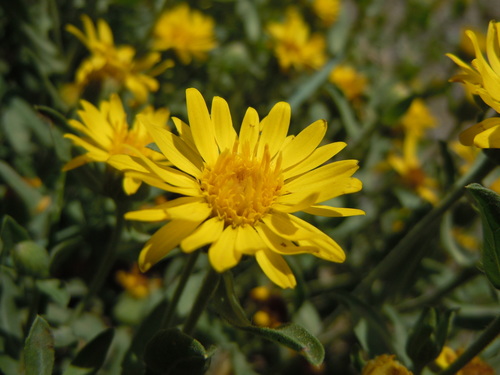
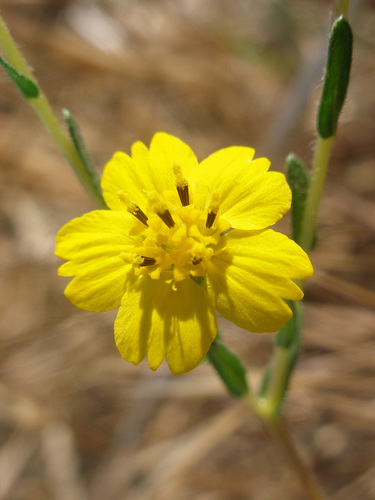
Deinandra fasciculata is an annual herb with thin, branched stems that grow erect to a maximum height of 100 cm (40 inches). Its upper leaves are narrow, around 1 centimeter long, and pressed against the stem, bearing more resemblance to short needles than typical leaves. The plant's lower leaves are much larger, growing up to 15 centimeters (6 inches) long. Each flower head contains a central cluster of six yellowish disc florets with black stamens, surrounded by five yellow ray florets. The ray florets usually have three teeth, with the central tooth being the smallest of the three. This plant flowers from May through October. In the Deinandra genus, the disc florets of this species are large enough to be visible as tiny individual flowers to the naked eye. The plant gives off a tar-like odor.
Deinandra fasciculata is native to Baja California and California. In California, it occurs primarily from San Diego County north to Monterey County, including several of the California Channel Islands. A small number of collections from the San Francisco Bay area are recorded in the Calflora database, but these are from urban locations and most likely represent cultivated specimens rather than naturally occurring populations. It is a common species in coastal grassland habitats within the California chaparral and woodlands ecoregion, as well as in other habitat types.
Deinandra fasciculata is pollinated by bees. Its mature seeds are primarily dispersed by gravity, falling directly from the seed heads when ripe. Seeds may also be dispersed by the many species of birds and small mammals that eat them. This species can hybridize with other members of the Deinandra genus, and also with species in the Hemizonia and Centromadia genera.