About Deinandra conjugens (D.D.Keck) B.G.Baldwin
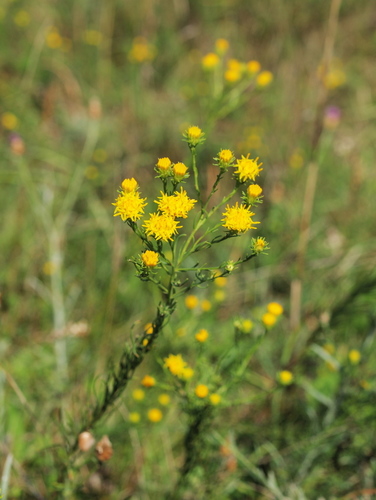
Deinandra conjugens is an annual herb that reaches a maximum height of around 0.5 meters (1.6 feet). It produces a solid, bristly stem marked with gland dots. Its lower leaves are hairy, with lobed or toothed edges, and grow up to roughly 4.5 centimeters long.
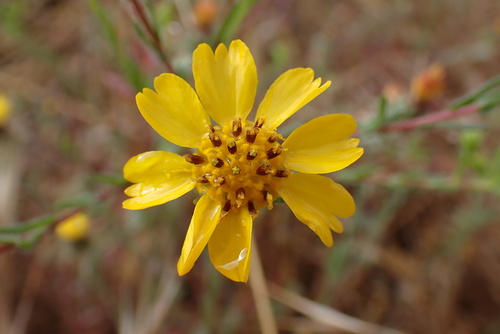
The plant's inflorescence consists of one or more flower heads; sometimes it produces many heads arranged in clusters. The underside of each flower head is covered in phyllaries that bear numerous glands. Each head holds 7 to 10 yellow ray florets, each no longer than 6 millimeters. Most ray florets have three tiny lobes at their tips. The center of the flower head is filled with yellow disc florets, whose anthers are tipped with black, dark purple, or red. Bees are the most common pollinators of this species.
The plant produces fruit in the form of an achene. Achenes that develop from disc florets have pappi made of white scales. Disc floret achenes germinate earlier than achenes from ray florets, and many achenes fall to the soil to form a persistent seed bank.
Deinandra conjugens grows in clay soils across multiple habitat types, including grassland, maritime coastal sage scrub, and inland coastal sage scrub. It can tolerate some level of habitat disturbance, and low-intensity grazing and road maintenance activities like mowing are likely beneficial to the species. Most of the currently known populations of Deinandra conjugens are located in San Diego County, California, United States. The majority of these populations occur in the southern part of the county, in regions including Otay Mesa and Proctor Valley. The city of San Diego maintains an official conservation plan for the species and conducts regular monitoring. Currently, there are approximately 34 to 37 remaining known populations; some previously recorded populations are thought to have been extirpated since the species received federal listing protection.