About Deinacrida heteracantha White, 1842
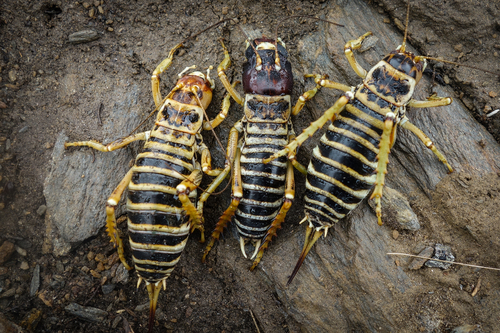
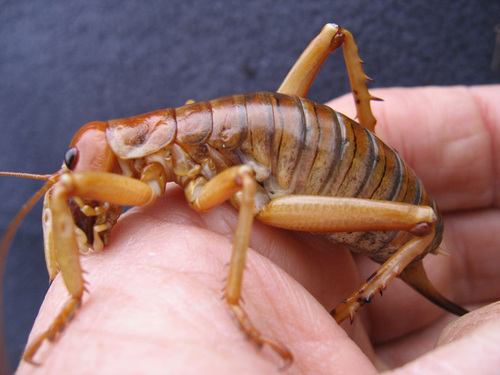
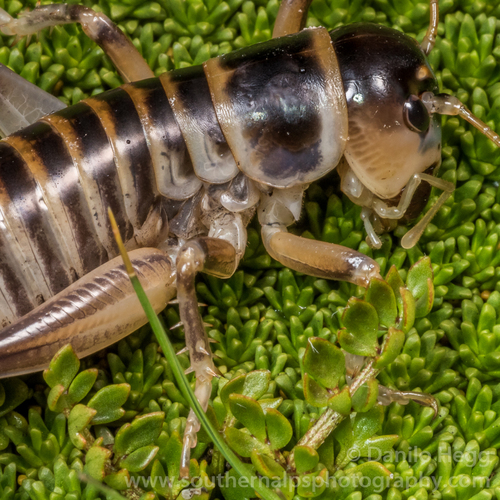
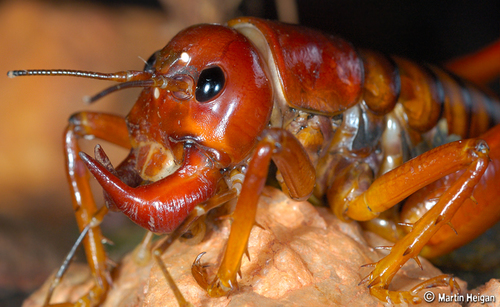
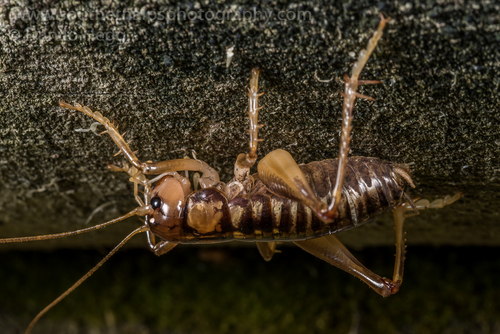
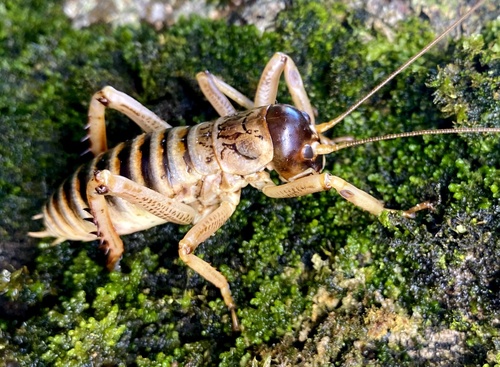
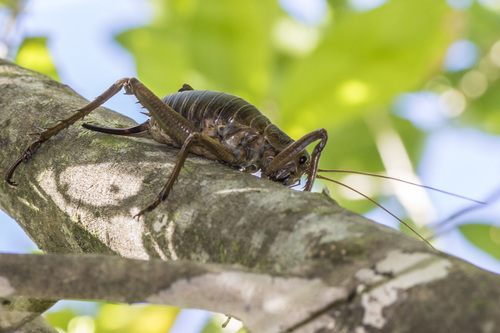
Deinacrida heteracantha, commonly called wētāpunga, is the largest species in the Deinacrida genus. This species is strongly sexually dimorphic: adult females are much larger than adult males. In captivity, gravid females can weigh up to 70 g (2.5 oz); average adult weight is 32 g for females and 7.4 g for males. Average adult female body length from head to abdominal tip is around 65 mm (2.6 in). These large wētā have a broad body, round head, and short mandibles. Like other wētā, their antennae are relatively short compared to other cricket species, they are wingless, and they can deliver a strong kick with their hind legs. The species is mainly herbivorous, feeding on forest foliage. White’s original 1842 description of D. heteracantha reads: Hind legs nearly twice the length of the insect; tibiae quadrangular, broadest behind, the edges armed with spines coming out alternately; spines very strong and sharp: body brown, beneath yellow: head punctured on the vertex; antennae at least 2 1⁄2 times the length of the insect: thorax punctured, with some small smoothish spaces in the middle; the lateral margins somewhat thickened: the head is not nearly so broad nor so large as in Anostostoma; the mandibles much shorter; the labial palpi have the terminal joint swollen at the end, when dry it is slightly compressed from shrinking; the maxillary palpi are very long; the three last joints cylindrical, the last longest, gradually clubbed at the end.
D. heteracantha are arboreal forest-dwelling insects currently found only on Little Barrier Island, a 3,083-hectare (7,620-acre) island off the coast of New Zealand. Historically, the species also lived in forests across warmer regions of New Zealand’s North Island, including Northland and Auckland, but it went extinct in these mainland areas during the 19th century. On Little Barrier Island, its habitat ranges from lower-slope second-growth forests to mid-level tall kauri forest. The dominant plant species in the island’s second-growth forest are silverfern, nīkau palm, mahoe, and kohekohe.
The life cycle of D. heteracantha is not tied to seasonal cycles, and individuals can live up to two years. Eggs are laid in summer, between October and December, and hatch the following year in March and April, with an average incubation period of 125 days. Only 36% of eggs survive to hatching. Mating occurs in most months of the year, excluding the winter months of June to August. Copulation begins in the morning and continues throughout the day; during this process, the male inserts a spermatophore into the female’s subgenital plate. Females lay eggs at night into moist soil, 2–3 cm deep, in areas of roughly 15 cm2. Eggs may be laid singly or in groups of up to five. Females produce an indefinite number of eggs, and continue laying eggs for the rest of their lives, but only a limited number of eggs are fertilized after each copulation. After hatching, nymphs go through ten instars before reaching maturity and eventually dying. The ovipositor becomes visible in female nymphs at the third instar, and clear sexual differences between males and females appear at the sixth instar. Each instar lasts an average of five to six weeks. Unlike other species in the Deinacrida genus, D. heteracantha goes through an extra instar; this extra developmental stage lengthens its nymphal period and allows it to grow to a larger overall body size. D. heteracantha has no courtship rituals, and no stridulatory mating signals have been observed. Individuals recognize the opposite sex exclusively through physical contact.