About Decticus verrucivorus (Linnaeus, 1758)
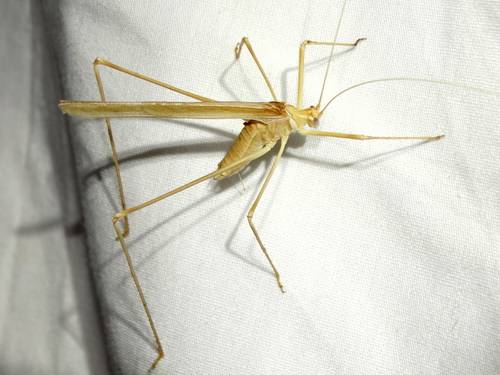
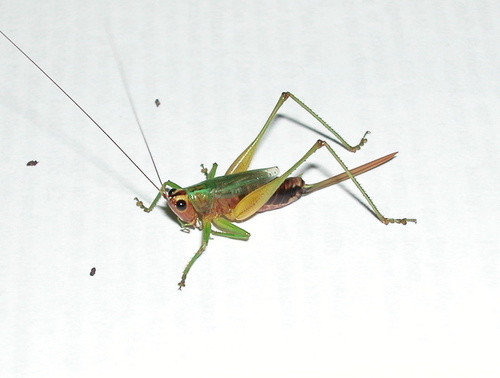
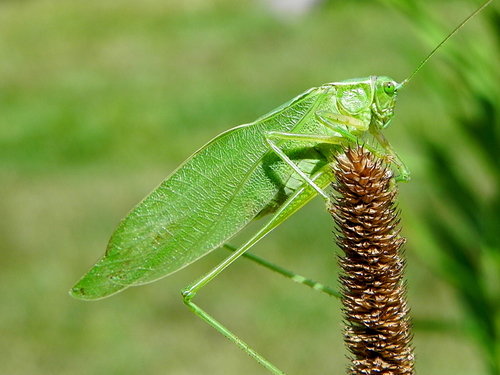
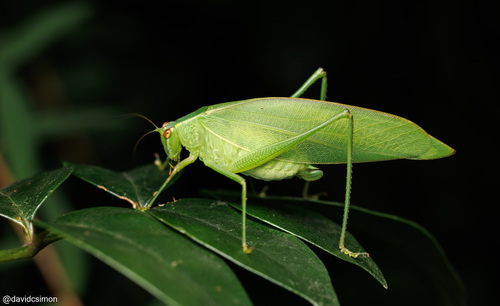
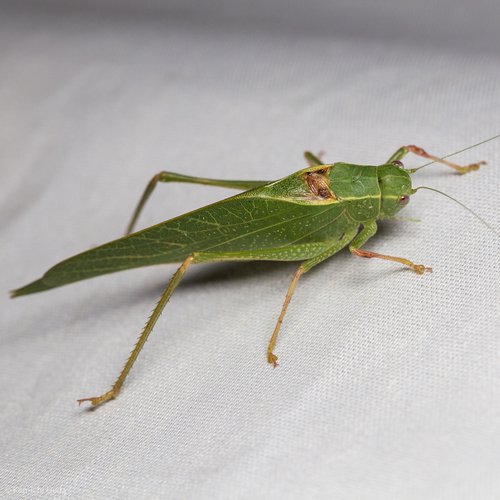
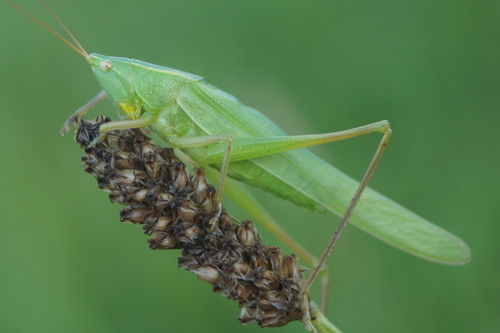
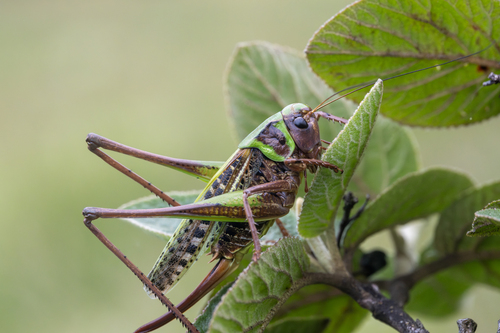
Description: Adult Decticus verrucivorus, commonly called wart-biters, measure 31–37 millimetres (1.2–1.5 in) in body length, with females significantly larger than males. Most individuals are dark green and shiny, and always have at least some dark brown mottling or blotches on the pronotum and wings. A mostly dark brown morphotype also exists, though this form is still mottled with patches of green. Females have a 20 mm long, slightly upcurved ovipositor. Their colouration provides effective camouflage in grassy environments. The wart-biter’s song is a rapidly repeated sequence of short click bursts that begins slowly and increases in speed, and may sometimes last for several minutes. This species only sings during sunny weather. Wart-biters usually travel by walking, and rarely fly except when frightened. Most individuals can only fly 3 to 4 metres (10 to 13 ft) in a single flight. Habitat: This species inhabits calcareous grassland and heathland. Wart-biters require a mosaic of vegetation that includes bare ground or short turf, grass tussocks, and a sward rich in flowering herbs. They prefer areas that are not heavily grazed. As a thermophilous species, it tends to occupy sites with a southerly aspect. Status and distribution: This species occurs across most of continental Europe, excluding the extreme south. Its range extends from southern Scandinavia south to Portugal, Spain, Italy, and Greece. It is also found in temperate Asia, reaching as far east as China. Geographic barriers such as mountains have fragmented this species’ populations, leading to a wide diversity of forms and numerous subspecies. In Britain, the wart-biter is restricted to five sites, with two located in East Sussex, and one each in Wiltshire, Essex, Dorset, and Kent. Life cycle: The wart-biter lays its eggs in soil, and these eggs typically hatch after passing two winters. After hatching, the species goes through seven instar stages between April and June. Adults emerge at the beginning of July. Wart-biter population numbers peak in late July and early August. Newly hatched Decticus verrucivorus are enclosed in a protective sheath that holds their legs and antennae close to the body to make their journey upward through the soil to the surface easier. They have an inflatable and deflatable neck section that enlarges the top of their tunnel to further ease their upward passage.