About Deconica montana (Pers.) P.D.Orton
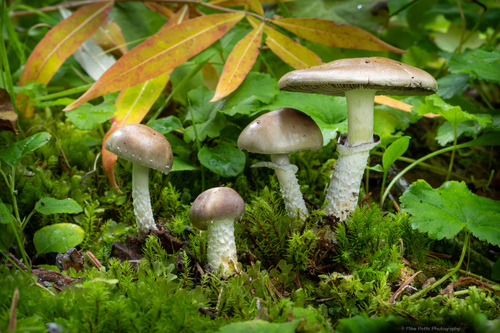
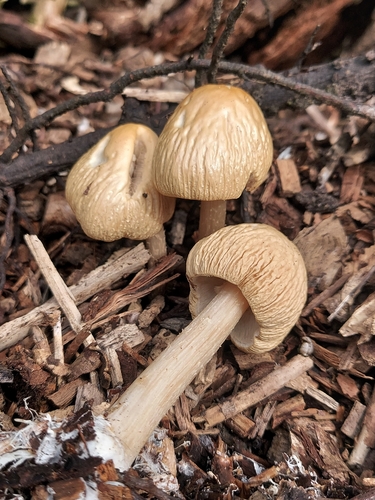
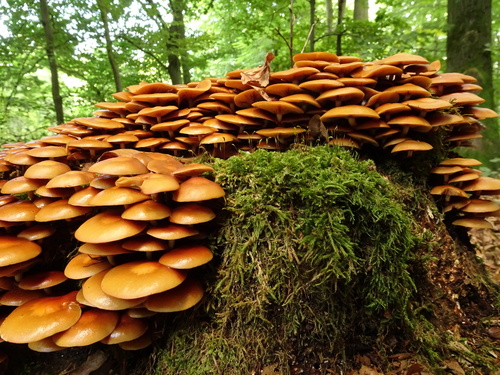
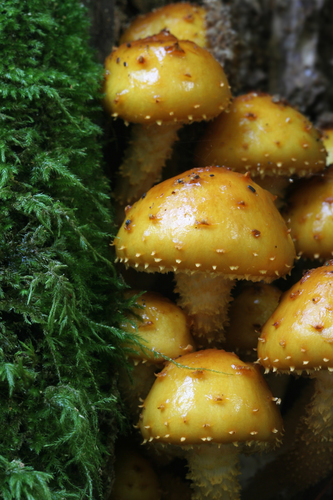
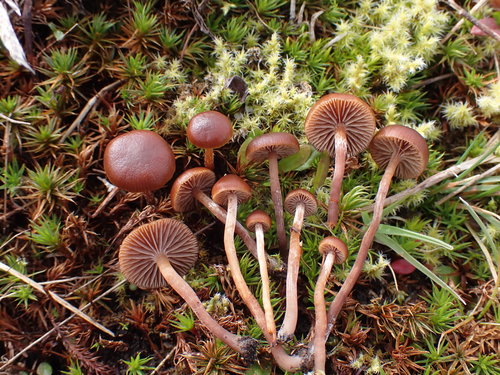
Deconica montana (Pers.) P.D.Orton has a cap 0.5–2 cm in diameter, which starts dome-shaped and becomes convex, somewhat flattened, and sometimes bears a broad umbo. The cap is moist, hairless, hygrophanous, and marked with radial striations extending to its center; its color ranges from reddish-brown to dark brown. The gills are adnate to broadly adnate, or sometimes very shortly decurrent, and match the cap in color. The stipe is 1.5–4 cm long, 1–2 mm thick, smooth, the same color as the cap, and brittle. Typical spores of the species measure 7.5–10 × 6–8 × 5–5.5 μm, are ovate–lentiform in shape, and have a thickened wall. A large-spored variety, Psilocybe montana var. macrospora Noordel. & Verduin (1999), with spores measuring 8.5–11 × 6.0–8.5 × 5.0–7.0 μm, has been reported from the Netherlands. The spore print of D. montana is dark greyish brown. The species is listed as inedible, as it is too small to be of use as food.
This species is commonly found in open, exposed habitats including dune-meadows, heaths, tree-less tundra, and open Pinus forests, and it typically grows on nutrient-poor, well-drained soil. It has a nearly cosmopolitan worldwide distribution, and has been reported from many regions across a wide range of climates: Britain (Thetford Forest), California (United States), the Caribbean, China (western Kunlun Mountains), Colombia (the high plains of Guasca), Greenland, Mexico, Nepal, Norway, alpine tundra, subalpine regions of Switzerland, the region that was formerly the USSR, the Venezuelan Andes, moss at high elevations in Idaho and Montana, Arctic tundra, and vegetation-covered flat roofs in Chemnitz, Germany.
Deconica montana is saprobic, and may also be parasitic. It is often associated with a range of moss species, including Brachythecium albicans, Brachythecium mutabulum, Campylopus introflexus, Ceratodon purpureus, Dicranum scoparium, Eurhynchium hians, Eurhynchium praelongum, Eurhynchium speciosum, Rhacomitrium canescens, Pohlia species, and Polytrichum piliferum.