About Decalobanthus peltatus (L.) A.R.Simões & Staples
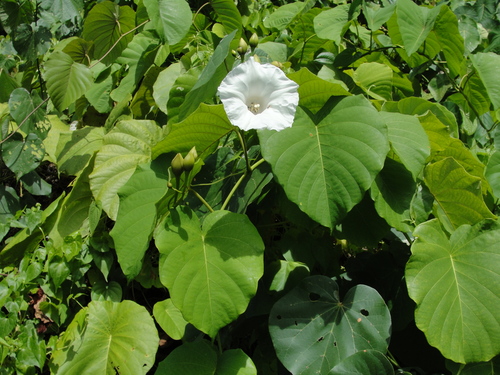
Decalobanthus peltatus is a flowering vine species belonging to the morning glory family, Convolvulaceae. It is native to Pemba Island, the Mascarene Islands, Madagascar, the Seychelles, Indonesia, Malaysia, the Philippines, northern Queensland (Australia) and French Polynesia. This species has been introduced to several other Pacific islands including New Caledonia, Samoa, Fiji, the Solomon Islands, and Palau, where it has since become invasive. As an invasive species in island habitats, Decalobanthus peltatus can grow to completely cover trees, smothering and killing native forest across large areas. The resulting tree death and forest loss reduces available food for native birds and fruit bats, and also increases soil erosion. Increased soil erosion in turn leads to higher sedimentation and the death of coral reefs. To eradicate invasive populations of this vine, cutting the vines at the base kills the upper growth and gives affected trees a chance to recover. Because vines will re-sprout from their cut bases, uprooting the entire plant is the preferred method when possible. However, repeated cutting will eventually exhaust and kill the vines. The seeds of this vine cannot germinate in shade, so the most effective way to prevent invasive issues with this species is to keep native forest intact. In Palau, where the vine is locally known as kebeas, community efforts have been organized to encourage members of the public to cut the vine with machetes, an activity that promotes both physical fitness and ecological stewardship.