About Daviesia ulicifolia Andrews
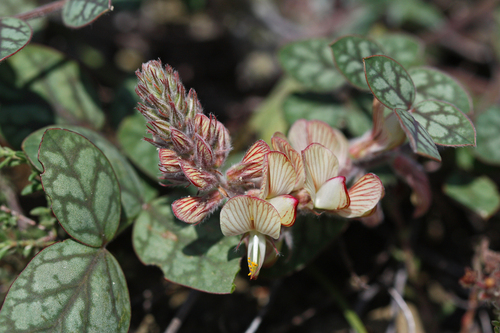
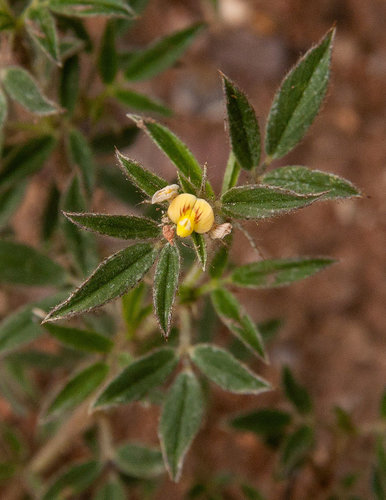
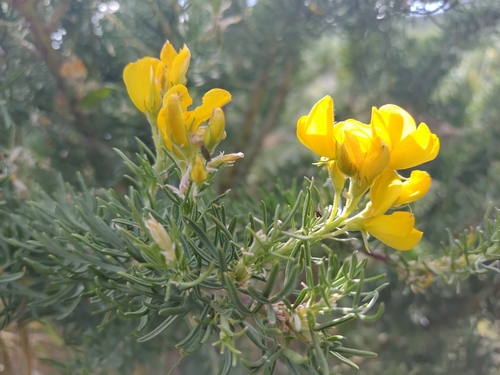
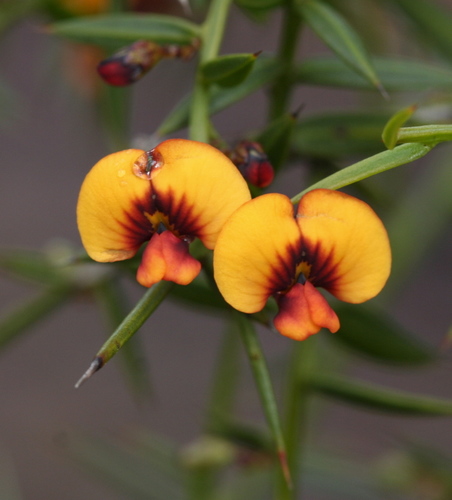
Daviesia ulicifolia is a rigid, openly branched shrub that usually grows up to 2.5 metres (8 feet 2 inches) tall, and has spiny branchlets. Its phyllodes are most often narrow elliptic or narrow egg-shaped, and rarely take a fully egg-shaped form. They measure 5–35 mm (0.20–1.38 in) long and 0.5–6 mm (0.020–0.236 in) wide, end in a sharp point, and have a prominent midrib on the upper surface. Flowers are arranged singly, in pairs, or sometimes in groups of up to seven, located in leaf axils. They sit on a peduncle up to 3 mm (0.12 in) long, with a rachis up to 1.1 mm (0.043 in) long, and each individual flower grows on a pedicel 0.5–5 mm (0.020–0.197 in) long. The sepals are 2–4 mm (0.079–0.157 in) long, and their five lobes are around 0.5–1 mm (0.020–0.039 in) long. Flower colour differs by subspecies. The standard petal is broadly egg-shaped with a notched tip, 3–6 mm (0.12–0.24 in) long and 3–10 mm (0.12–0.39 in) wide. It is usually yellow or orange-yellow, with a red ring surrounding a yellow centre. The wing petals are 4–6 mm (0.16–0.24 in) long, and coloured yellow and dark red. The keel petal is 4–5 mm (0.16–0.20 in) long, and coloured maroon to red. Flowering occurs from August to October, with timing varying based on elevation and latitude. The fruit this species produces is a flattened triangular pod 5–8 mm (0.20–0.31 in) long. Gorse bitter-pea, the common name for Daviesia ulicifolia, is widely distributed across Australia. It grows in open forest, and occurs in all six Australian states, but not in the Northern Territory. Subspecies aridicola grows in arid areas of the Great Victoria Desert and Murchison bioregions of Western Australia, across a broad area of South Australia, and in the far south-west of New South Wales. Subspecies incarnata grows in hilly or mountainous areas of the Mount Lofty Ranges in South Australia, and in a small number of isolated locations further south. Subspecies pilligensis grows in heathy woodland and open forest from south-eastern Queensland to the western slopes of New South Wales, and is especially common in the Pilliga Scrub. Subspecies ruscifolia grows in forest from central New South Wales and the Australian Capital Territory to Grampians National Park in Victoria, and also occurs in Tasmania. Subspecies stenophylla is mostly found in coastal areas, often growing in disturbed habitats from the wet tropics of far north Queensland to the Central Coast of New South Wales. Subspecies ulicifolia mostly grows in forest, and is widespread from south-eastern Queensland, through most of Victoria to south-eastern South Australia and Tasmania.