About Daviesia mimosoides R.Br.
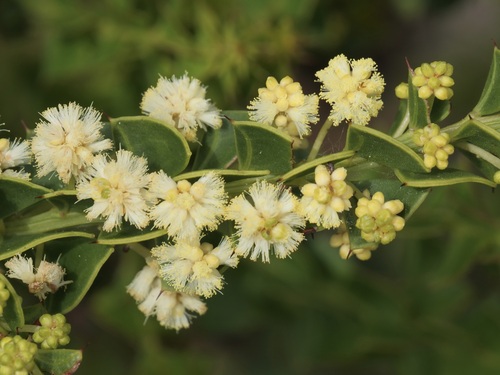
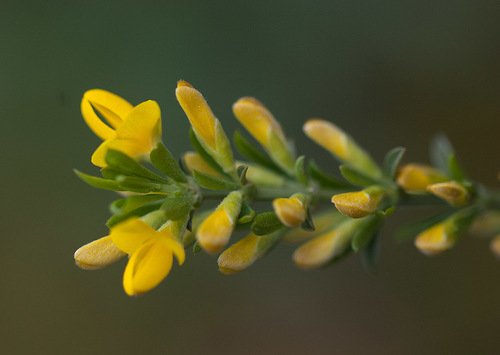
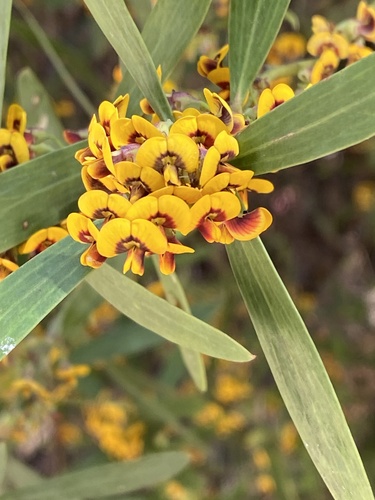
Daviesia mimosoides R.Br., commonly known as blunt-leaf bitter-pea, is an open shrub that usually grows up to 2 metres (6 feet 7 inches) tall, rarely growing as a tree-like plant reaching 5 metres (16 feet) tall. It produces many hairless, glabrous branches. Its phyllodes are mostly narrowly elliptic, but can sometimes be linear or egg-shaped with the narrower end oriented towards the base. They range from 15 to 200 millimetres (0.59 to 7.87 inches) long and 4 to 30 millimetres (0.16 to 1.18 inches) wide. Flowers are usually arranged in one or two racemes holding five to ten flowers each, located in leaf axils. The peduncle is 1 to 5 millimetres (0.039 to 0.197 inches) long, and the rachis is 4 to 12 millimetres (0.16 to 0.47 inches) long, with narrowly oblong bracts at its base. The sepals are 2.5 to 5 millimetres (0.098 to 0.197 inches) long and joined at the base. The upper two sepals lobes are joined for most of their length, while the lower three lobes are triangular and 0.3 to 0.6 millimetres (0.012 to 0.024 inches) long. The standard petal is broadly elliptic to egg-shaped, orange-yellow with dark brownish-red or maroon markings and a yellow centre, and measures 6 to 7.5 millimetres (0.24 to 0.30 inches) long. The wing petals are 5.0 to 6.75 millimetres (0.197 to 0.266 inches) long, dark brownish-red or maroon with yellow tips. The keel petal is 4.0 to 4.5 millimetres (0.16 to 0.18 inches) long and maroon. Flowering occurs mainly in September and October. The fruit is a flattened, triangular pod that is 6 to 10 millimetres (0.24 to 0.39 inches) long. Blunt-leaf bitter-pea grows in the understorey of open forest, ranging from south-east Queensland through eastern New South Wales and the Australian Capital Territory to eastern Victoria. It grows at altitudes from sea level up to 1,500 metres (4,900 ft). The subspecies Daviesia mimosoides acris, subspecies acris, is restricted to exposed rocky peaks. It occurs from the Brindabella Range in the Australian Capital Territory, through southern New South Wales, to eastern Victoria, growing at altitudes above 1,200 metres (3,900 ft).