About Daviesia latifolia R.Br.
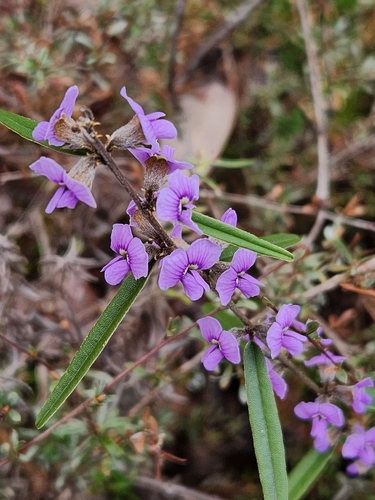
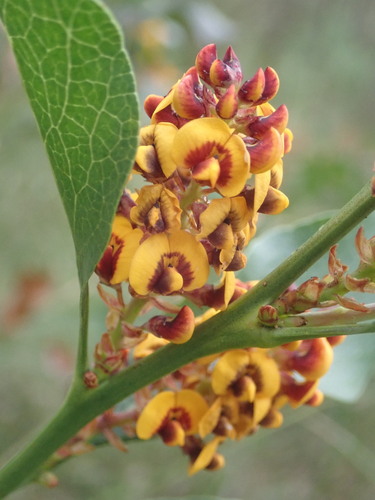
Daviesia latifolia R.Br., commonly known as hop bitter-pea, is a slender, erect shrub that typically reaches 1–5 m in height and 1.0–1.5 m in width, with arching, glabrous branches. Adult phyllodes are elliptic, egg-shaped, or lance-shaped, 20–150 mm long and 5–70 mm wide, growing from a petiole-like base 3–20 mm long. The phyllodes have a wavy texture, scalloped edges, and prominent veins; juvenile phyllodes are slightly broader than adult ones. Flowers are produced in leaf axils, arranged in up to three racemes. The raceme peduncle is 10–20 mm long, the rachis 25–80 mm long, and each individual flower sits on a pedicel 1.5–4 mm long. The sepals are 3–5 mm long and joined at the base; the upper two sepals are joined for most of their length, and the lower three are triangular and 0.5–1 mm long. The standard petal is broadly egg-shaped, 6–9 mm long, and coloured orange-yellow and maroon with a yellow centre. The wings are 5.5–8 mm long and coloured yellow and maroon, and the keel is 4.5–5.5 mm long and maroon. Flowering occurs between September and December, and the fruit is a triangular pod 6.5–11 mm long. Hop bitter-pea grows in forest, often as an understorey plant, at altitudes up to 1,800 m. Its natural range extends from the Granite Belt of south-eastern Queensland, through the tablelands, western slopes, and south coast of New South Wales, to most of Victoria excluding the north-west of the state. It is also common in dry woodlands in Tasmania. This species of Daviesia provides nectar for a range of insects and native birds. In horticulture, D. latifolia is used as an ornamental plant, for windbreaks, and for nitrogen fixation. It prefers well-drained soil in full sun and is frost tolerant. Other uses include: stems and phyllodes can be used with alum to produce a fawn dye that is used as a mordant; the phyllodes have reputed medicinal properties, and were substituted for hops to flavour beer; early European settlers used the leaves as a drug to expel intestinal worms (including to treat hydatid cysts), and also as a tonic.