About Daviesia arborea W.Hill
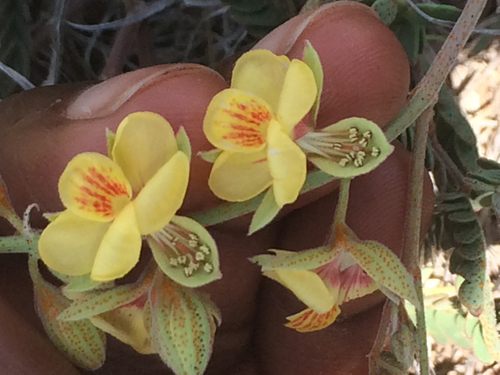
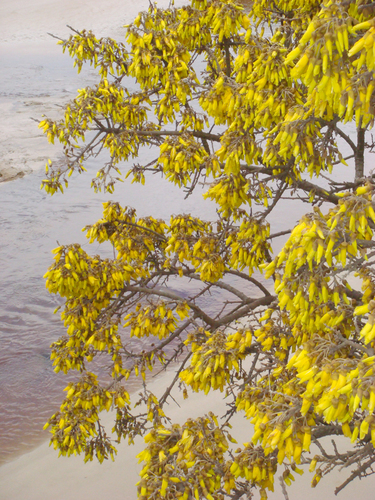
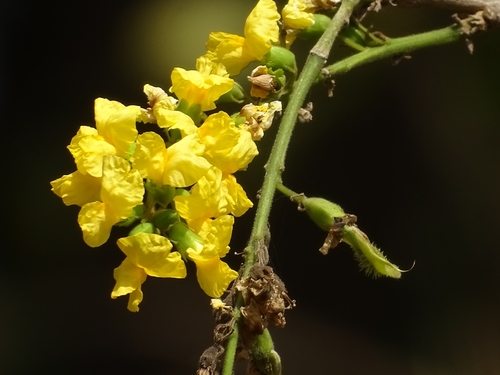
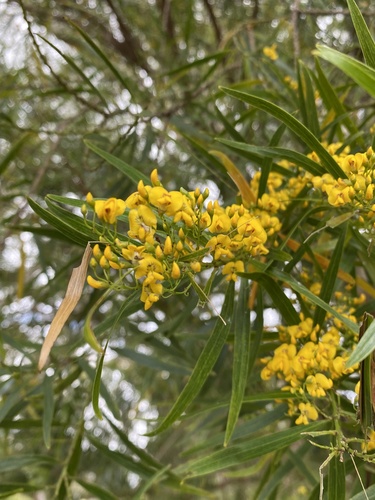
Daviesia arborea W.Hill is a shrub or small tree that typically grows to a height of up to 14 m (46 ft), with weeping branches and corky bark. Its phyllodes are linear to elliptic, 40–200 mm (1.6–7.9 in) long and 4–12 mm (0.16–0.47 in) wide, with fine parallel veins, and the lower surface of the phyllodes is paler than the upper surface. The flowers are arranged in racemes of eight to fifteen flowers, on a flowering stem 10–27 mm (0.39–1.06 in) long that includes a 2–4 mm (0.079–0.157 in) long peduncle; each individual flower sits on a 2–8 mm (0.079–0.315 in) long pedicel. The five sepals are 4.0–5.5 mm (0.16–0.22 in) long and joined at the base; the upper two sepals are joined into a shortened lip, while the lower three are shorter and triangular. The standard petal is yellow with red markings around a yellow centre, and measures 7–8 mm (0.28–0.31 in) long and wide. The wings are about 7.5 mm (0.30 in) long, and the keel is yellow and dark red, and about 5 mm (0.20 in) long. Flowering occurs from September to October, and the fruit is a triangular pod 7–9 mm (0.28–0.35 in) long. Commonly called golden pea, this species mostly grows in moist forest on coastal hills and mountain slopes, ranging from the Bunya Mountains in south-east Queensland to near Comboyne in New South Wales. For horticultural use, this large shrub is an attractive plant with its drooping branches and clusters of sweet-smelling flowers that bloom in spring. It can be grown from scarified seed, and grows best in a semi-shaded, moist location with well-drained soil.