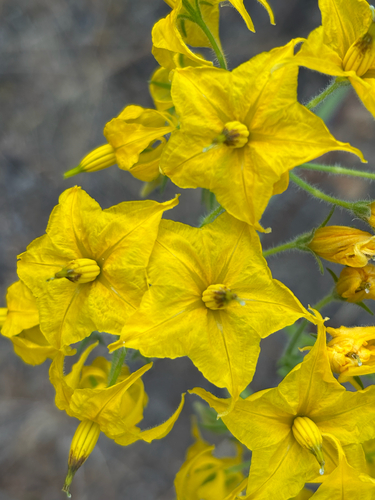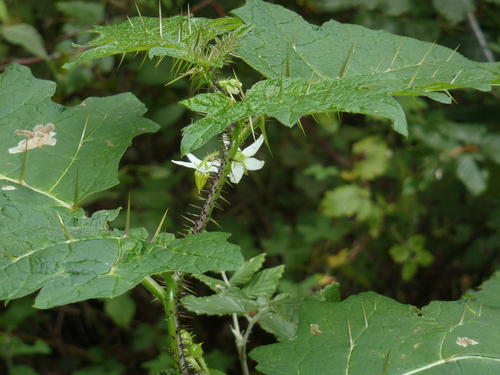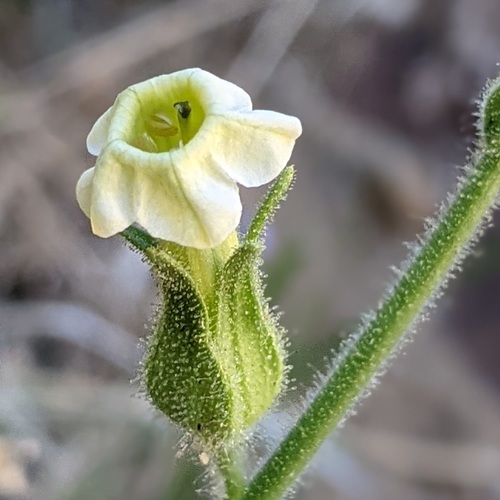
About Datura stramonium L.
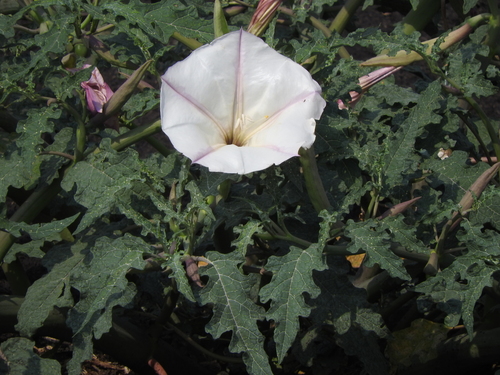
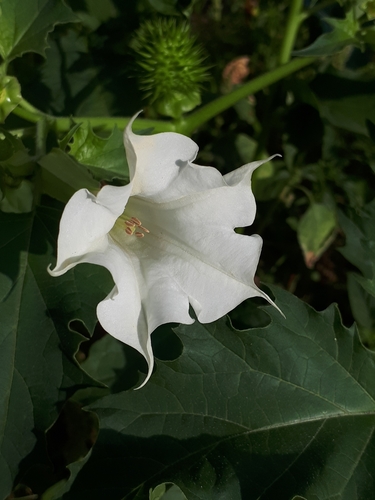
Datura stramonium L. is an erect, freely branching annual herb that grows into a bush 60 to 150 cm (2 to 5 ft) tall. It has a long, thick, fibrous, white root. Its stout, erect, leafy, smooth stem ranges in color from pale yellow-green to reddish purple, and forks repeatedly into branches; each fork produces one leaf and a single erect flower. Its leaves are approximately 8 to 20 cm (3–8 in) long, with a smooth, soft texture, toothed edges, and irregularly undulated margins. The upper leaf surface is darker green, while the lower surface is lighter green. Leaves have a bitter, nauseating taste that transfers to herb extracts and persists even after drying. This species generally flowers throughout the summer. Its fragrant, trumpet-shaped flowers are 6 to 9 cm (2+1⁄2–3+1⁄2 in) long, and range in color from white to creamy or violet. Flowers grow on short stems, emerging from either leaf axils or branch fork points. The long tubular calyx is swollen at the base, sharply angled, and topped with five sharp teeth. The folded, only partially open corolla is white, funnel-shaped, and marked with prominent ribs. Flowers open at night, release a pleasant fragrance, and are fed on by nocturnal moths. The species produces egg-shaped seed capsules 3 to 8 cm (1–3 in) in diameter, which may be either spiny or smooth. When mature, the capsule splits into four chambers, each holding dozens of small black seeds.
Datura stramonium is native to Central America, and spread widely to the Old World early, where it has become naturalized. It was scientifically described and named by Swedish botanist Carl Linnaeus in 1753, though it had already been described a century earlier by botanists including Nicholas Culpeper. Today it grows wild in all warm and temperate regions of the world, most often along roadsides and in dung-rich livestock enclosures. In Europe, it grows as a weed in garbage dumps and wastelands, and is toxic to animals that consume it. In South Africa, it has the common Afrikaans colloquial name malpitte, meaning 'mad seeds'. Observational evidence suggests its seeds are carried by birds and spread via bird droppings. Its seeds can lie dormant underground for years, and germinate when the soil is disturbed. The Royal Horticultural Society advises gardeners who find this plant to dig it up or arrange for its removal, and to wear gloves while handling it.
All parts of Datura stramonium contain dangerous levels of the tropane alkaloids atropine, hyoscyamine, and scopolamine, which are classified as deliriants and anticholinergics. Uninformed users face a high risk of fatal overdose, and many hospitalizations occur among recreational users who ingest the plant for its psychoactive effects. Poisoning from smoking jimsonweed and related Datura species, both deliberate and accidental, has been reported. Numerous other alkaloids have been detected at lower levels in the plant: methylecgonine in roots, apoatropine in stems, leaves, and other parts, and tropine in flowers and other parts. Toxin levels vary widely between individual plants, with variation as high as 20:1 between plants. A given plant's toxicity depends on its age, growing location, and local weather conditions. A particularly large difference is seen between plants from the species' native range and plants naturalized in non-native ranges: non-native plants may have atropine and scopolamine concentrations 20 to 40 times lower than native plants, which is suspected to be an evolutionary response to lower predatory pressure. Toxin concentration also varies between different parts of the same plant, and even between different leaves on one plant. In younger plants, the ratio of scopolamine to atropine is approximately 3:1; after flowering, this ratio reverses, and scopolamine levels continue to decrease as the plant ages. In traditional cultures, extensive experience and detailed knowledge of Datura was required to minimize harm from use. A single seed contains around 0.1 mg of atropine, and the approximate fatal dose for adult humans is more than 10 mg of atropine, or more than 2–4 mg of scopolamine.
A recent rodent study investigating a methanolic extract from whole Datura stramonium plants found significant behavioural and neurochemical effects. The extract caused memory deficits, alongside anxiogenic and depressive-like behaviours. These effects were linked to elevated lipid peroxidation and a marked depletion of antioxidant enzymes in the brain. Histological analysis found disrupted neuronal morphology in the hippocampus and medial prefrontal cortex, which provides evidence of the plant's neurotoxic potential. Datura intoxication typically causes delirium, hallucination, hyperthermia, tachycardia, abnormal behaviour, urinary retention, and severe mydriasis that leads to painful photophobia; symptoms can last for several days. Pronounced amnesia is another commonly reported effect. Symptoms generally begin 30 to 60 minutes after ingesting the plant, and last 24 to 48 hours, though some cases have reported symptoms lasting up to two weeks. As with other anticholinergic poisoning cases, intravenous physostigmine can be given as an antidote for severe cases.
In December 2022, around 200 people reported becoming ill after eating spinach-containing products sold mostly through Costco in Australia. Datura stramonium was identified as the contaminant, as its young leaves had been harvested alongside spinach. Increased rainfall had allowed the weed to spread. The grower, Riviera Farms, based in Gippsland, Victoria, acted quickly to eradicate the weed.
Atropine, one of the main active compounds in Datura stramonium, has been used in traditional medicine and for recreational purposes for centuries. The leaves are most commonly smoked, either in cigarettes or pipes. In the late 18th century, James Anderson, English Physician General of the East India Company, learned of this practice and popularized it in Europe. Traditional Chinese medicine also used Datura stramonium as an anesthetic during surgery. In 1597, John Gerard's Herball recorded that the juice of thornapple (Datura stramonium) boiled with hog's grease cures all inflammations, and all types of burns and scalds—from fire, water, boiling lead, gunpowder, or lightning—in a very short time, as Gerard stated he had tested this in daily practice. In the late 18th century, William Lewis reported that Datura stramonium juice could be made into a very powerful remedy for various convulsive and spasmodic disorders, including epilepsy and mania, and also found it eased external inflammations and haemorrhoids. In his 19th-century work On Asthma: its Pathology and Treatment, Henry Hyde Salter discussed Datura stramonium as an asthma treatment. Smoking herbs including Datura stramonium was thought to provide relief for people with asthma from antiquity through the early 20th century. The use of smoked Datura stramonium for asthma later declined, after asthma was understood to be an allergic inflammatory reaction, and new pharmacological developments produced more effective treatments.
Datura stramonium grows best in rich, calcareous soil. Adding nitrogen fertilizer to soil increases the concentration of alkaloids in the plant. It can be grown from seed, sown with several feet of space between individual plants. It is sensitive to frost, so requires shelter during cold weather. The plant is harvested when fruits are ripe but still green. For harvest, the entire plant is cut down, leaves are stripped from the stem, and all plant material is left to dry. Seeds are harvested when fruits begin to burst open. In intensive plantations, it is possible to get leaf yields of 1,100 to 1,700 kilograms per hectare (1,000 to 1,500 lb/acre), and seed yields of 780 kg/ha (700 lb/acre).