About Dasymalla terminalis Endl.
Taxon Identity and Growth Form
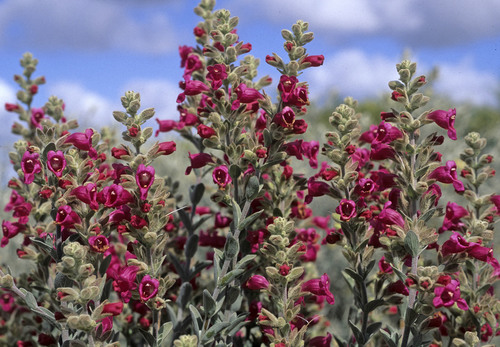
Dasymalla terminalis Endl. is an erect shrub that grows 0.5 to 1 meter (2 to 3 feet) tall. Its branches and leaves are densely covered in white or grey woolly hairs.
Leaf Shape and Size
The leaves are oblong to narrowly elliptic, measuring 2 to 3.5 centimeters (0.8 to 1 inch) long and 0.8 to 1.5 centimeters (0.3 to 0.6 inches) wide. They are thick and soft, and covered with small pimples that are hidden by the thick layer of woolly hairs.
Flower Coloration
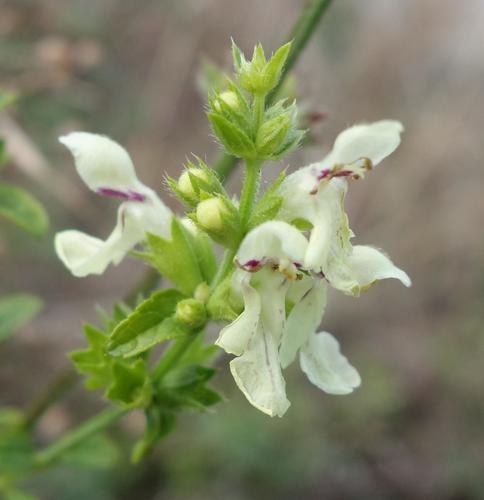
Flowers are pale to deep pinkish-purple or claret red; a form occurring near Lake Grace produces white flowers.
Flower Arrangement
Flowers are arranged in leaf axils in groups of up to five, growing on a densely hairy stalk 3 to 5 millimeters (0.1 to 0.2 inches) long.
Floral Bracts
Flowers are surrounded by woolly bracts and bracteoles that are hairy on the outside and glabrous on the inside.
Sepal Morphology
The five sepals are 1 to 1.5 centimeters (0.4 to 0.6 inches) long, joined at the base to form a short tube that is woolly on the outside and glabrous on the inside.
Petal Tube Structure
The five petals are joined to form a tube 15 to 20 millimeters (0.6 to 0.8 inches) long, and 8 to 10 millimeters (0.3 to 0.4 inches) wide in its upper half, with five lobes at the end. The petal tube has scattered hairs on the outside and is glabrous on the inside, except for a ring of hairs near the ovary.
Petal Lobe Size
The lower petal lobe is more or less circular, and almost twice as large as the other four lobes, which are roughly equal in size.
Stamen Morphology
The four stamens are shorter than the petal tube, with one pair slightly shorter than the other.
Flowering Period
Flowering occurs from May to November or December.
Fruit Characteristics
After flowering, a hairy fruit develops that splits into two when mature.
Genus Distribution Rank
This Dasymalla species is the most widely distributed in its genus.
Geographic Range
It grows from near the Murchison River in the north-west to Kalgoorlie in the south-east of Western Australia, occurring in the Avon Wheatbelt, Coolgardie, Esperance Plains, Geraldton Sandplains, Mallee, Murchison and Yalgoo biogeographic regions.