About Dasiphora fruticosa (L.) Rydb.
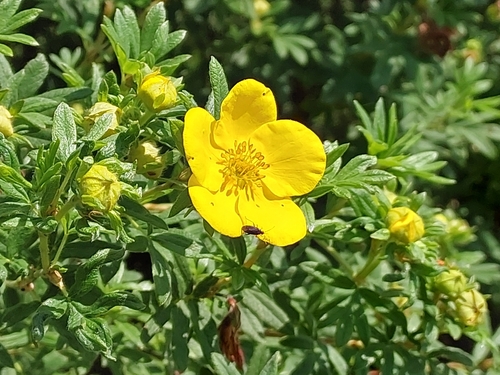
Dasiphora fruticosa (L.) Rydb. typically grows 0.1–1 m (3.9–39.4 in) tall, and rarely reaches up to 1.5 m (4.9 ft). Its growth habit ranges from upright to sprawling or prostrate, though stems are often ascending, especially stems that develop many long branches. Older stems have shreddy bark that peels into long, thin strips. Plants are densely leafy, with leaves divided into five or seven pinnate leaflets; three or nine leaflets occur occasionally. Leaflets are linear-oblong, 3–20 mm (0.1–0.8 in) long, have smooth entire margins, and have more or less pointed acute ends. Foliage, including both leaves and young stems, is pubescent, variably covered in fine, silky, silvery hairs around 1 mm long. Flowers grow at the tips of stems, are 2–3 cm (0.8–1.2 in) across, and have a buttercup shape. Each flower has five petals and 15–25 stamens; petals range from pale to bright yellow, and are orange to reddish in some populations from western China. The fruit is a cluster of long-haired achenes. This species may be dioecious or bisexual, and flowering typically occurs from early to late summer. It usually grows in moisture-retentive soils in swamps and rocky areas. Wildlife usually only eat this plant when other food sources are scarce, and its leaves can be boiled to make an herbal tisane called kuril tea. Commonly called shrubby cinquefoil, it is a popular ornamental plant in temperate regions. Different cultivars vary in flower color, ranging from white to yellow, orange, and pink, and all cultivars are hardy plants that flower for most of the summer. Flowers are consistently small, flat, and round, with dozens of blooms produced on each bush. It is very frequently used for landscaping by cities and businesses due to its hardiness and low maintenance requirements. It was first introduced to cultivation in the 18th century, while many modern cultivars, especially those with orange or red flowers, originate from collections made by Reginald Farrer in western China in the early 20th century. Most sellers and gardeners still refer to this species by its older scientific name, Potentilla fruticosa. The combination of small leaves, delicate flowers, and orange to brown flaky bark makes shrubby cinquefoil well-suited for bonsai cultivation. It is very popular for bonsai in Japan, and is growing in popularity in Europe.