About Darwinia procera B.G.Briggs
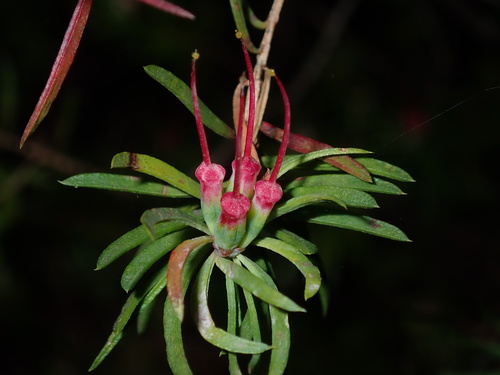
Darwinia procera B.G.Briggs is an erect shrub that reaches a height of approximately 3 meters (10 feet), and has upright branches. Its leaves are laterally compressed, arranged in a decussate pattern along the branches. They measure 10–25 millimeters (0.4–1 inch) long, are glabrous, have a bluish tinge, curve upwards, and taper to a pointed tip. Flowers are arranged in clusters of around four at the ends of branches, with each flower growing from a stalk 1–2 millimeters (0.04–0.08 inches) long. The clusters are surrounded by reddish bracts that are 4–13 millimeters (0.2–0.5 inches) long. The floral cup is 5–8 millimeters (0.2–0.3 inches) long and about 2 millimeters (0.08 inches) wide, and the petals form a white tube that surrounds and encloses the stamens. The style is white, measures 14–20 millimeters (0.6–0.8 inches) long, and extends beyond the end of the flower tube. Flowering occurs between late winter and early summer. This Darwinia species grows in forest and scrub near the tops of sandstone gullies on the central coast north of Sydney. In horticulture, Darwinia procera is reasonably well known, valued for its unusual foliage. It can be propagated from seed, but is easier to grow from cuttings. It is hardy when grown in well-drained, sandy soil in a partly-shaded location, and requires occasional watering during long dry spells.