About Darwinia fascicularis Rudge
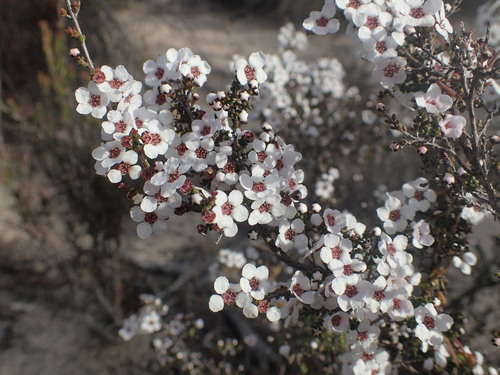
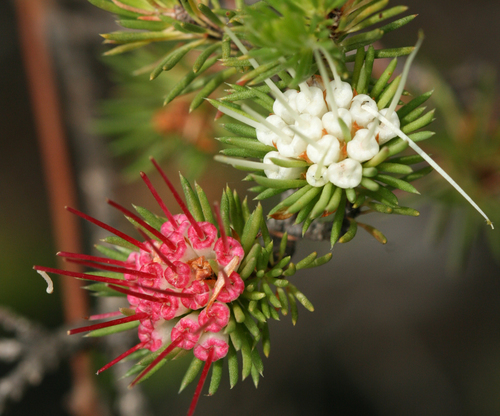
Darwinia fascicularis is a pleasantly scented small shrub that grows 1.5–2.5 m (4.9–8.2 ft) tall. Its small, light green leaves are needle-like, almost cylindrical, smooth, and 8–16 mm (0.31–0.63 in) long. The leaves are crowded and arranged opposite or in whorls on spreading branches. The flowers grow on 1 mm (0.039 in) long peduncles, and are initially white. They form pin-cushion-like clusters of 4 to 20 flowers at the ends of branches, turning red as they age. The prominent styles are straight or curved, 12–18 mm (0.47–0.71 in) long, and can be either white or red. The bracts are dry, translucent, 2–14 mm (0.079–0.55 in) long, and are either leaf-like or triangular in shape. Smaller bracts are 3–5 mm (0.12–0.20 in) long, may be oblong or triangular, and fall off early. The tubular flowers are 5–7 mm (0.20–0.28 in) long, 1–1.5 mm (0.039–0.059 in) in diameter, with rounded ribbing. The sepals are usually toothed, triangular, and about half the length of the petals. Flowering occurs from June to September. This species is distributed from Gosford on the Central Coast, south to Bulli near Wollongong. It grows in poor sandy soils within dry eucalyptus forest or heathlands in high rainfall areas. In horticulture, Darwinia fascicularis is a hardy species suited to open, sunny positions with well-drained soil. The species attracts several native birds that feed on its nectar, including the New Holland honeyeater (Phylidonyris novaehollandiae), tawny-crowned honeyeater (Gliciphila melanops), and eastern spinebill (Acanthorhynchus tenuirostris). The Darwinia genus is believed to be predominantly pollinated by birds.