About Danaus chrysippus petilia (Stoll, 1790)
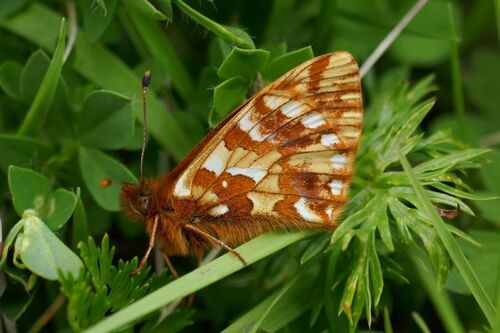
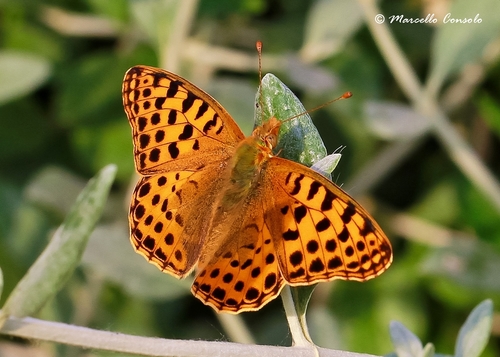
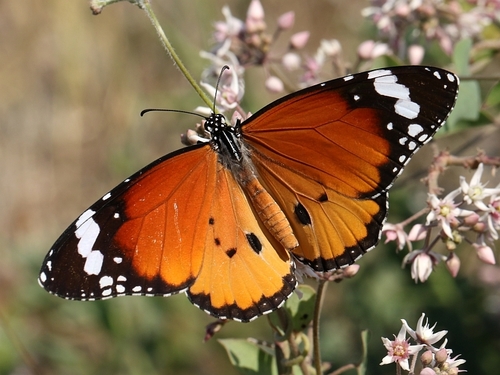
Danaus chrysippus, commonly called the plain tiger, is a medium-sized butterfly with a wingspan of approximately 7–8 cm (2.8–3.1 in). Its body is black with white spots, and its wings are brownish orange, with the upper side a brighter, richer shade than the underside. The apical half of the forewing is black with a white band; the hindwing has three black spots in its center. All wings are bordered in black, outlined with semicircular white spots. This species shows slight sexual dimorphism: males have large scent glands on their hindwings that females lack, which appear as a large black spot with a white center when viewed from the underside. D. chrysippus is a polymorphic species, so exact coloration and patterning vary within and between populations. It is similar in appearance to the Indian fritillary (Argynnis hyperbius), with which it may coexist. The plain tiger occurs across the entire African continent, where the predominant subspecies is D. c. alcippus. Its range extends across most of Asia including the entire Indian subcontinent, as well as many South Pacific islands, parts of Australia, Southern Europe and Kuwait. D. c. chrysippus is most common throughout Asia and in select regions of Africa; D. c. orientis is found in more tropical African regions and some African islands, including Madagascar and the Seychelles. Plain tigers are classified as bioinvaders in North America. The plain tiger prefers arid, open areas, and can be found in a wide range of habitats including deserts, mountains, deciduous forests, and human-tended gardens in cities and parks. It tolerates altitudes from sea level up to around 1,500 m (4,900 ft). The larval host plants of the plain tiger belong to several families, with the most important being Asclepiadoideae (Apocynaceae). Recorded host plants in this subfamily are: Apteranthes burchardii (recorded from the Canary Islands/Spain), Asclepias (milkweeds, recorded on A. cancellata, A. coarctata, A. curassavica, A. fulva, A. kaessneri, A. lineolata, A. reflexa, A. scabrifolia, A. semilunata, A. stenophylla, A. swynnertonii, A. syriaca), Aspidoglossum interruptum, Calotropis (mudar, recorded on C. gigantea, C. procera), Ceropegia dichotoma (recorded from the Canary Islands/Spain), Cryptolepis dubia, Cynanchum (recorded on C. abyssinicum, C. acutum, C. altiscandens, C. amplexicaule, C. carnosum, C. floribundum, C. pulchellum, C. rostellatum, C. sublanceolatum), Gomphocarpus (recorded on G. fruticosus, G. physocarpus), Kanahia laniflora, Leichhardtia australis, Leptadenia lanceolata, Orbea variegata (recorded from the Canary Islands/Spain), Pentatropis (recorded on P. atropurpurea, P. quinquepartita), Pergularia daemia, Periploca linearifolia, Secamone (recorded on S. afzelii, S. parvifolia, S. platystigma), Stapelia gigantea, Stathmostelma (recorded on S. gigantiflorum, S. pedunculatum), and Vincetoxicum (recorded on V. cernuum, V. sylvaticum, V. tanakae). Host plants from other plant families include Dyerophytum indicum (Plumbaginaceae), Ficus (Moraceae; recorded on F. laevis, F. racemosa), Ipomoea (Convolvulaceae; recorded on I. alba, I. bona-nox), Lepisanthes rubiginosa (Sapindaceae), as well as some members of Euphorbiaceae, Malvaceae, Poaceae, Rosaceae and Scrophulariaceae. Adult plain tiger butterflies feed on nectar from various flowering plants. The specific plant species they use vary based on the geographic range of the butterfly population and the season, as not all of these plants flower year-round.