About Dampiera rosmarinifolia Schltdl.
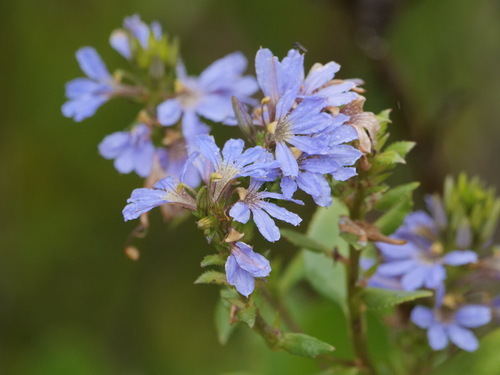
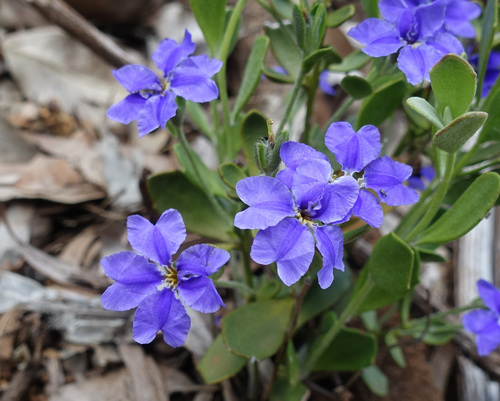
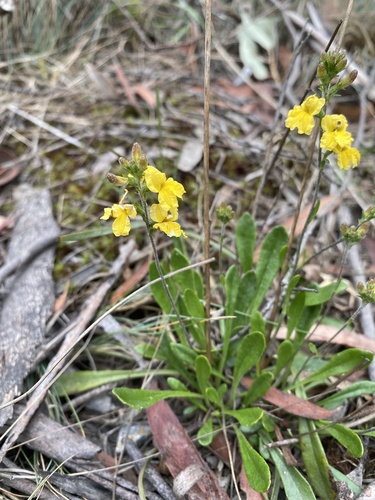
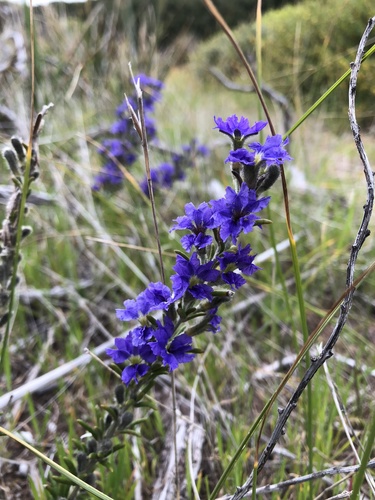
Dampiera rosmarinifolia is an upright or prostrate perennial subshrub that grows up to 60 cm (24 in) high. It has ribbed, needle-shaped stems covered in whitish branched hairs, which often become smooth as the plant ages. Its leaves range from linear to elliptic in shape, measuring 9–26 mm (0.35–1.02 in) long and 2–5 mm (0.079–0.197 in) wide. Most leaves are sessile, crowded, and often grow in clusters from the same leaf node. The upper leaf surface is smooth and glossy, while the underside bears short, soft hairs and has rolled margins. Inflorescences typically hold a single flower, with up to 3 flowers growing in upper leaf axils; each flower sits on a 3–5 mm (0.12–0.20 in) long pedicel. Bracteoles are narrowly elliptic, 1–2 mm (0.039–0.079 in) long. Sepals are 1–1.5 mm (0.039–0.059 in) long, covered in short, matted hairs. The corolla is purple-blue or pink on the inside, with a tube roughly 1.6 mm (0.063 in) long, and bears flattened grey to black hairs on the outside. Posterior corolla lobes are narrowly curved to oblong, 4–5 mm (0.16–0.20 in) long. Anterior corolla lobes are narrowly lance-shaped, 4–6 mm (0.16–0.24 in) long. Flowering typically occurs from August to November. The fruit is egg-shaped with its narrower end at the base, it is grey, hairy, and 2–4 mm (0.079–0.157 in) long. This species, commonly called rosemary dampiera, usually grows in low-rainfall areas in mallee and scrub habitats on sandy soils, ranging from north-western Victoria to the Eyre Peninsula in South Australia.