About Dampiera purpurea R.Br.
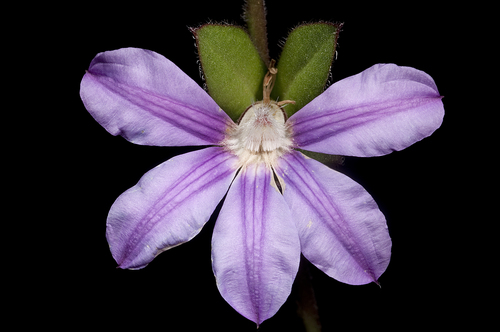
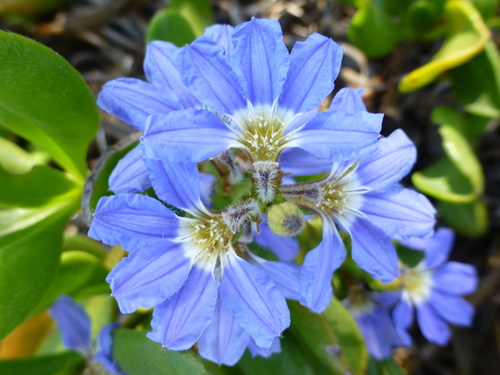
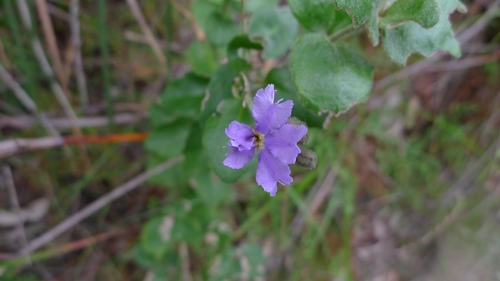
Dampiera purpurea R.Br. is an erect, multi-stemmed plant that grows up to 1 metre (3.3 feet) high. Its leaves are obovate to elliptic, measuring 0.9 to 6 cm (0.35 to 2.36 in) long and 0.5 to 4.2 cm (0.20 to 1.65 in) wide. Stems and the undersides of leaves are covered in fine hairs and have a rough texture, while mature upper leaf surfaces are hairless. In its native range, this species produces flowers mostly between August and January. Three to five flowers grow on each of two to nine flowering branches. Flowers reach 2.5 cm (1 in) across, are most commonly blue-purple with yellow centres, though pink and white blooms have also been recorded. Dampiera purpurea grows in sclerophyll forest and heath in Victoria, New South Wales and Queensland. In the Sydney region, it grows under trees including smooth-barked apple (Angophora costata), yellow bloodwood (Corymbia eximia), red bloodwood (C. gummifera), blackbutt (Eucalyptus pilularis), monkey gum (E. cypellocarpa), silvertop ash (E. sieberi) and Sydney peppermint (E. piperita). It grows predominantly on sandstone-based soils, and sometimes on clay soils, generally in well-drained locations where annual rainfall ranges from 800 to 1600 mm. This species is killed by bushfire, and new shoots grow from ground level after fire. These new shoots can flower within ten months, and flowering peaks around two to three years after a fire. It also regenerates from seed after fire. Butterflies from the Lycaenidae and Hesperiidae families, and European honeybees, forage on its flowers and are likely pollinators. Dampiera purpurea can be cultivated in cool to subtropical climates. It is a variable species, which is reflected in the number of different forms grown in cultivation. It prefers lightly shaded positions, but can also adapt to full sun, and has some degree of frost tolerance. It adapts to most reasonably drained soils, but grows more vigorously in heavier soils. Steady moisture through spring and summer produces the best growth, though established plants can withstand dry periods. Light pruning after flowering keeps plants neat and shapely. It can be propagated by cuttings or division.