About Damora pandora (Denis & Schiffermüller), 1775
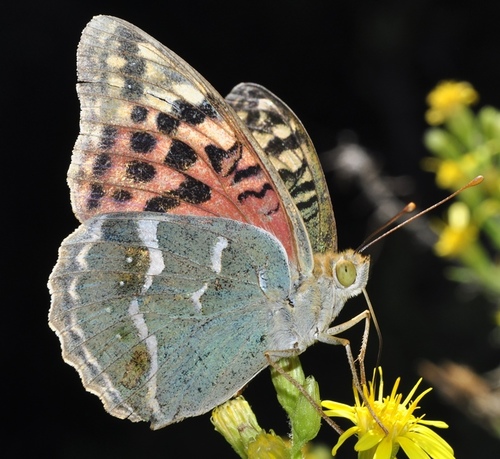
Scientific name: Damora pandora (Denis & Schiffermüller), 1775. This description follows the account in Seitz. The wingspan of this species measures 64–80 mm. This species, previously referenced as A. pandora Schiff. (= cinara F., maja Cr.) (71c), is the largest European Argynnis. The upper side of the wings strongly resembles that of A. valesina, but is a brighter greenish shade, and is densely covered with black spots. The underside is quite distinct: the apex of the forewing and the entire hindwing are bright green, the disc of the forewing is fleshy red with deep black spots, and the hindwing bears a small number of narrow bands that are more white than silvery, with strong variation in the number and development of these bands. The aberrant form ab. dacica Horinuz., a valesina-like morph from Romania, has a darkened basal area on both wings that contrasts with the distal area, which is slightly paler than it is in typical individuals. The subspecies pasargades Fruhst., currently recognized as A. p. pasargades, originates from the Alexander Mountains. It has a completely pale upperside, this paleness is especially noticeable on the forewing, which has almost no trace of green. This subspecies is also paler yellow on the underside, and its black markings are reduced in size. The subspecies seitzi Fruhst., currently recognized as A. p. seitzi Fruhstorfer, 1908 (71c), was described from specimens collected by Stichel in the Aures Mountains of Algeria. Individuals of this subspecies are larger than European specimens of the species, they are paler green on the underside and darker greenish yellow on the upperside; their black markings are more prominent, more abundant, and often confluent. The form paupercula Ragusa lacks silvery white bands and spots; it is the locally prevalent form especially in southern districts, such as Algeria. Fully grown larvae are purplish brown with a black head. They do not have the yellow dorsal stripe seen in the larvae of Argynnis paphia, and are otherwise similar to paphia larvae, except their spines are shorter. Each body segment bears a velvety black spot on the back that is marked with 2 white dashes. Larvae develop on Viola host plants until June. The species occurs primarily in Mediterranean countries, with a documented range that includes North Africa, the Canary Islands, Spain, southern France extending north to the Valais (where it approaches the German frontier), Italy, southern Austria-Hungary, Turkey, Asia Minor, and eastward as far as the Tian-shan. It is abundant in some localities. Adult butterflies are active starting in June; their flight is fast and graceful, described as rushing or swimming. They typically settle on tree branches that overhang roads, or on thistle heads.