About Damnacanthus indicus C.F.Gaertn.
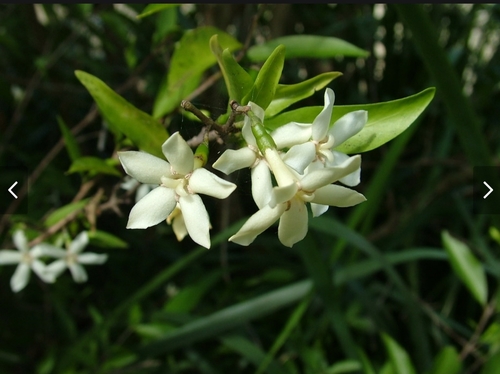
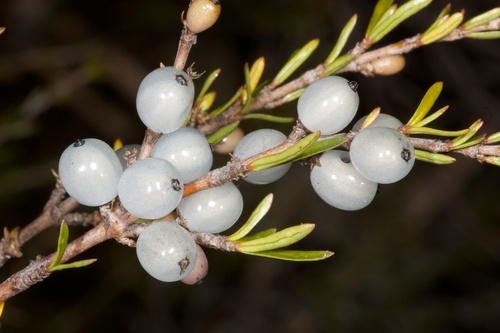
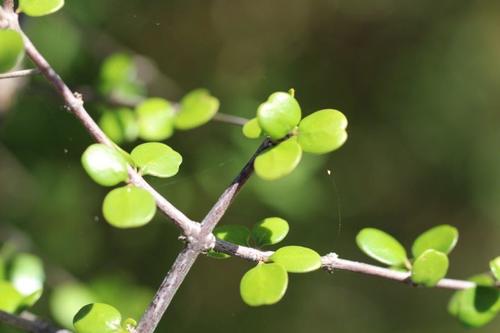
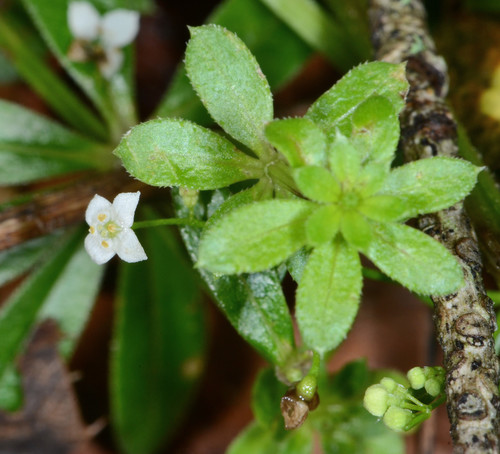
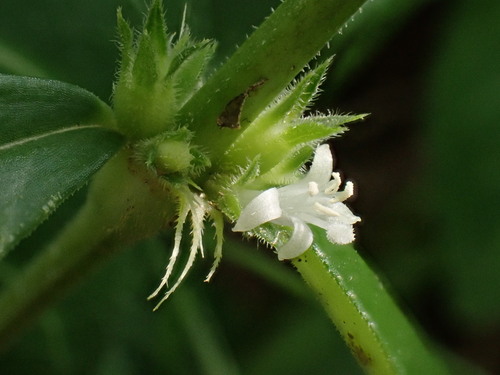
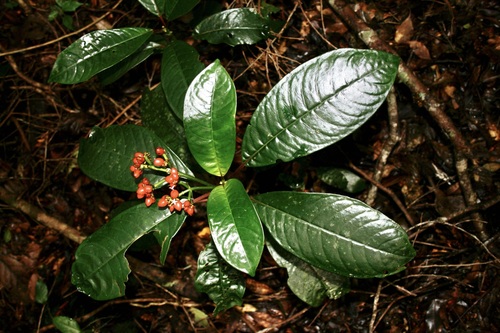
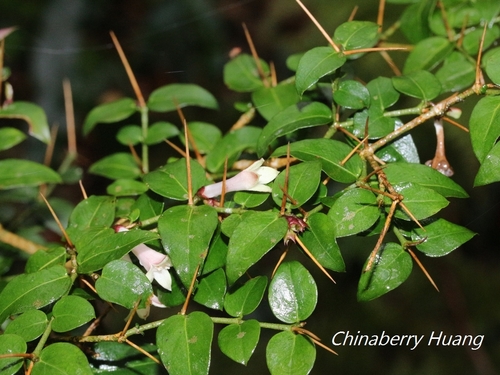
Damnacanthus indicus C.F.Gaertn. is a shrub that can reach up to 4 meters in height. Spines develop on winter buds and terminal buds of twigs, measuring 3 - 5 mm in length. The leaves are opposite to sub - opposite or clustered on short twigs, thin, narrowly oblong - ovate, 9 - 15 × 2.5 - 5.0 cm in size, with 5 - 6 lateral veins, pointed tips, and pointed or rounded bases. The leaf back may or may not have hairs and has slight roughness. The petiole is 1 - 2 cm long. The plant is dioecious. Flowers are in clusters, with 10 - 30 male flowers and 2 - 6 female flowers. Female flowers have stamen vestiges, and the style is divided about halfway into two parts. The calyx lobes are triangular, and the petals are very small, yellow - green, half the size of the calyx lobes. The pedicel is 5 - 7 mm, with or without hairs. The fruit and seeds are drupes, black in color. The fruit stalk is 5 - 12 mm, glabrous, and the seeds have grooves. The flowering period is from late April to late May, and the fruiting period is from July to August. It is distributed in central - southern China, central - southern Honshu, Japan, as well as Gyeonggi - do, Hwanghae - do, North Pyongan - do, and North Jeolla - do in Korea (the distribution in Hamgyong - namdo and Hamgyong - bukdo is somewhat doubtful). Regarding taxonomic views, the Flora of China mentions two species, R. utilis Decne. and R. ussuriensis J.J.Vassil, which have spines compared to plants with developed terminal buds in winter buds. The former has yellowish leaf backs with yellow hairs on the main veins when dried, while the latter is green with white hairs on the main veins. Also, the petiole of the former is 5 - 15 mm short, while that of the latter is 15 - 30 mm long. However, it is impossible to distinguish the two species by these traits, so they are regarded as the same taxon. Geographically, they are also indistinguishable, so the scientific name of R. utilis with priority is used here. R. shozyoensis Nakai is mainly found in North Pyongan - do but is considered a synonym of the true species. Geographically, this species is confirmed in areas such as Gyeonggi - do and Chungcheong - do, excluding Gangwon - do, and is classified as a species. More in - depth research on this taxon is needed.