About Dalibarda repens L.
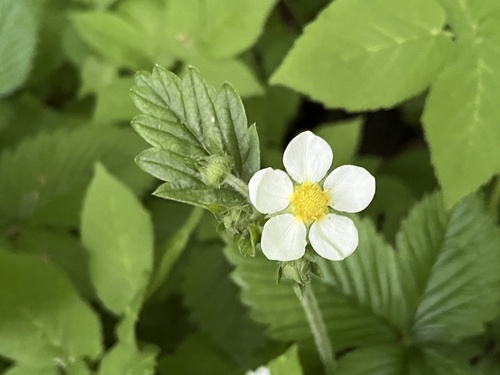
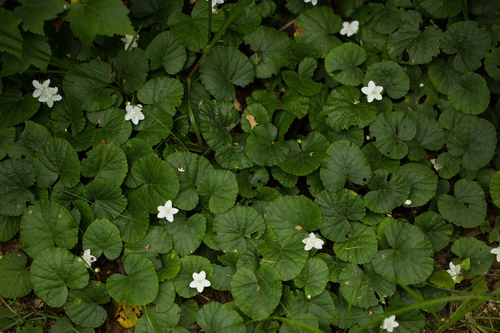
Dalibarda repens L. (also called Rubus repens, common names false violet and dewdrop) is a herbaceous creeping plant, and it is the only species in the genus Dalibarda. This species produces two types of flowers: sterile and fertile. Sterile flowers are far less numerous than fertile flowers; they have five white petals and grow at the top of a peduncle. Fertile flowers are more numerous, cleistogamous—meaning they are self-pollinating and never open—and hidden underneath the plant's leaves. The peduncles of these cleistogamous flowers are short, measuring 2–5 cm long, and curved downward. The calyx forms a shallow, hairy hypanthium divided into 5–6 lobes of unequal size, with the 3 larger lobes having serrated (toothed) edges. Its stems are decumbent (creeping), several inches long, with a densely tufted terminal portion that bears both leaves and flowers. Its leaves are basal, simple, pinnately veined above the base, long-petiolate, and slightly hairy or downy on both sides, and dark green in color. Leaf blades are cordate (heart-shaped) to orbicular (rounded), 3–5 cm long, with rounded basal lobes, a blunt to rounded apex, and crenate (scalloped with low rounded teeth) margins. Hairy leaf petioles measure 3–10 cm long. The common name false violet comes from both the plant's heart-shaped leaves and its production of two kinds of flowers, a trait it shares with violets. While the species is globally secure, it is locally endangered in Connecticut, New Jersey, North Carolina, and Rhode Island, and listed as threatened in Michigan and Ohio. This is a low-growing plant, reaching 2 to 5 inches in total height, that spreads via runners; leaves and flowers grow on separate stalks emerging from these runners. Sterile flowers are white, with 5 broad petals and numerous long stamens, and grow singly on a long, reddish flower stalk that arises from the runner. Its leaves are kidney-shaped with a long petiole and a scalloped outer margin. Dewdrop leaves can be confused with violet leaves; the two can be distinguished because violets have low rounded teeth that curve upward, while dewdrop leaf margins have low scalloped edges or outward-facing blunt teeth. This plant's range extends from Minnesota in the west to Nova Scotia in the east, south to Michigan, Pennsylvania, and New Jersey, and into the mountains as far south as North Carolina. It grows in northern or upland forests in shady spots, in moist to wet conifer and mixedwood (softwood and hardwood) forests or swamps, and often occurs on red pine and white pine sites with sandy, acidic soil; it thrives best in acidic soil. It produces a small number of nearly dry, small white drupelets (3–4 mm long) that are retained inside the calyx. Like its close relatives in the genus Rubus, young Dalibarda repens plants make a reasonably palatable pot-herb, and can be brewed into a mild infusion or tea at any point during the growing season. Its fruit is edible, but is not considered a choice edible. It flowers from June to August.