About Dalea searlsiae (A.Gray) Barneby
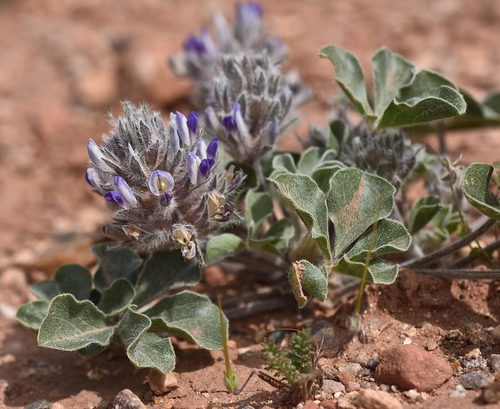
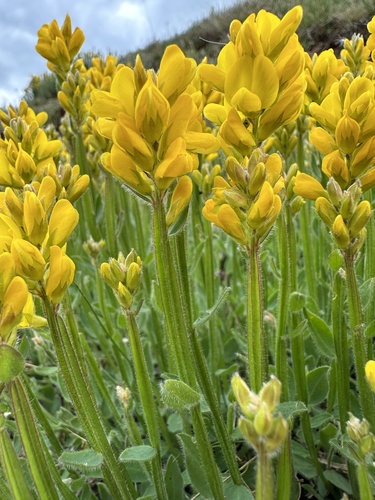
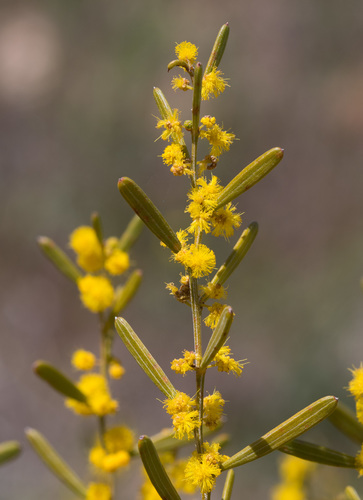
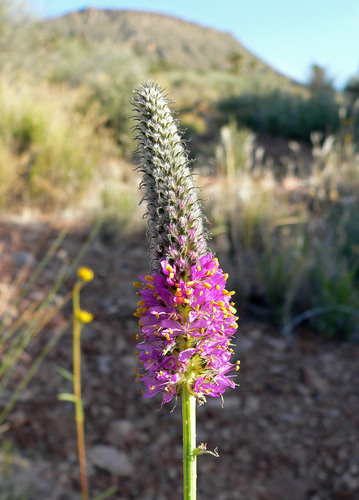
Dalea searlsiae, commonly known as Searls’ prairie clover, is a perennial legume species in the Dalea genus, with a woody taproot that supports its perennial life cycle. Each spring, the plant regrows multiple stems from this taproot. Its leaves are odd-pinnately compound, alternating, and deciduous; they most often have 5 or 7 leaflets, though the total number can range from 3 to 11 depending on the plant’s age and health. Mature Searls’ prairie clover plants grow to between 25 and 60 centimeters tall. Flowering begins in early spring, and seeds mature by early July. The species produces tiny perfect flowers that cluster together in cylindrical spikes. Each flower and its resulting pod has five stamens and two ovules, but only one seed matures per pod. Searls’ prairie clover is native to the southwestern United States. While it is rarer than many other legume species, its metapopulations occur in southeastern California, Utah, Nevada, and Arizona. Nothing is currently known about the species’ distribution south of the US-Mexico border. The species is most commonly found in desert shrublands and forested woodlands. Within the southwestern United States, it is abundant in pine-juniper forests, and much rarer in spruce-fir forests. It can survive in a wide range of soil types, including clay-rich soils, sandy substrates, and rocky flats, though its biological fitness and seed yield decrease in soils with high clay content. It is most often found in lime-rich soils. As an interior North American species, it grows at elevations between 1000 and 2800 meters above sea level. Most existing ecological research on Searls’ prairie clover focuses on its symbioses and interactions with herbivores. The species is capable of self-pollinating when pollinators are not present, but it preferentially cross-pollinates when pollinators are available. Studies show self-pollination results in a significantly lower number of seeds, and most self-pollinated seeds are not viable. The presence of Searls’ prairie clover supports a diverse pollinator community in the ecosystems where it grows. Bees are the primary pollinators of Dalea searlsiae, with 22 native bee species identified as its main pollinators. These include potter bees (genus Anthidium), bumblebees (genus Bombus), plaster bees (genus Colletes), and long-horned bees (genera Eucera and Melissodes). Various species of wasps, flies, and butterflies also act as important non-bee pollinators for the species. Three phenotypically and genetically distinct germplasms of Dalea searlsiae, identified by Bhattarai et al. in 2011, are used for land revegetation and restoration projects. The ‘Fanny’ germplasm was sourced from seeds collected at Patterson Pass in east-central Nevada, and is recommended for USDA Plant Hardiness Zone 5b. The ‘Carmel’ germplasm originates from the Colorado Plateau in south-central Utah, and is recommended for USDA Plant Hardiness Zone 7a. The Bonneville germplasm was collected from northwestern Utah near the Nevada border, which falls in USDA Plant Hardiness Zone 6b. This germplasm is genetically distinct from the other two, and is recommended for use specifically in northwestern Utah. Using local germplasms is recommended to avoid outbreeding depression. All three germplasms have been made available for revegetation and restoration work by the USDA Agricultural Research Service. In 2015, researchers collected seeds from the regions originally identified by Bhattarai et al. (2011), developed new germplasms for future cultivation, and confirmed the genotype of each new germplasm via genetic testing. Planting seeds for restoration and cultivation requires pre-germination treatment. Planting seeds in fall and allowing them to overwinter is an effective pretreatment method. Many projects instead use a 5-minute treatment with 98% sulfuric acid to improve germination rates. Established plants grow well without irrigation, but in drier years, applying 100 to 200 millimeters of irrigation can increase seed yield.