About Dalea purpurea Vent.
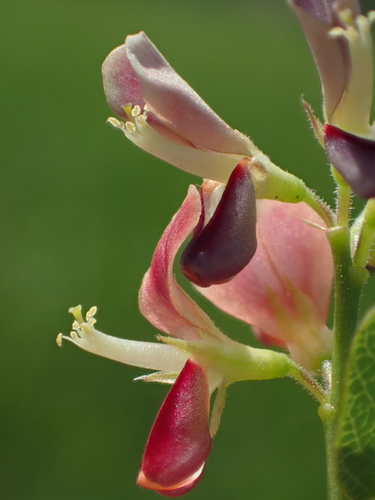
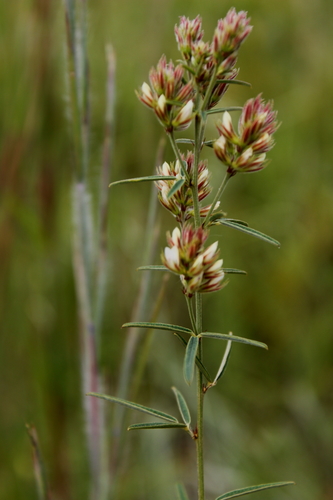
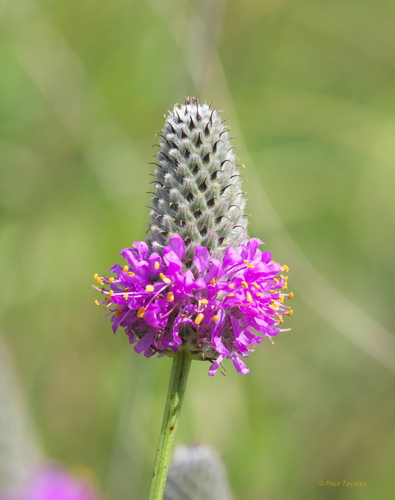
Dalea purpurea Vent. is a perennial herb that grows 20 to 90 cm (8 to 35 inches) tall. Mature plants have a large taproot reaching 1.7 to 2.0 m (5.5 to 6.5 feet) deep. Its stem is woody with several branches. Its leaves, which are a few centimeters long, are divided into 3 to 7 narrow leaflets. At the top of each stem branch, an inflorescence forms a spike up to 7 cm (2 3/4 inches) long that holds many purple flowers. The fruit is a legume pod containing 1 to 2 seeds. The Latin specific epithet purpurea translates to purple.
Dalea purpurea is native to central North America. It occurs from central Canada to the southeastern and southwestern United States, except the east and west coasts. It is common and widespread across its range, particularly on the Great Plains. Meriwether Lewis collected a specimen of this species in Nebraska in 1804.
This plant is adapted to habitats that experience periodic wildfires. In some regions, it relies on fire to remove encroaching woody vegetation, as it cannot tolerate shade. It is a common member of the flora on the plains of central North America, growing in a variety of habitat types including several types of grassland. It occurs in glades, riverbanks, floodplains, oak woodlands, pinyon-juniper woodlands, shrubsteppe, many types of forests, and the Sand Hills of Nebraska. It also grows across various prairie ecosystems. On tallgrass prairie, it associates with plants including little bluestem (Schizachyrium scoparium), big bluestem (Andropogon gerardi), prairie Junegrass (Koeleria macrantha), prairie dropseed (Sporobolus heterolepis), lead plant (Amorpha canescens), and silky aster (Symphyotrichum sericeum). On midgrass prairie, it grows alongside grasses including silver bluestem (Bothriochloa saccharoides), purple threeawn (Aristida purpurea), sideoats grama (Bouteloua curtipendula), and sand dropseed (Sporobolus cryptandrus). On shortgrass prairie, it associates with grasses such as blue grama (Bouteloua gracilis), hairy grama (B. hirsuta), and buffalo grass (B. dactyloides). This species may be considered an indicator of pristine prairie.
The nectar and pollen of Dalea purpurea attract many bees, wasps, flies, butterflies, and skippers. Several plasterer bees of the genus Colletes are specialist pollinators of Dalea species, and other insects eat the species' seeds and leaves. It is a larval host to the southern dogface (Zerene cesonia).
This species is used for revegetation efforts on reclaimed land, such as strip-mined land. It is good for preventing erosion and for fixing nitrogen in soil. Though it is often found in mid- to late-successional stages of ecological succession, it may also be a pioneer species that takes hold in bare and disturbed habitat such as roadsides. Purple prairie clover provides food for a number of animals, including pronghorn. It also grows in cultivated fields and becomes included in hay for livestock. It is nutritious and is considered one of the most important legumes in native grasslands on the Great Plains. It also had a number of uses for Native Americans: the leaves are edible and good for making tea and medicines, the roots are palatable when chewed, and the Pawnee people used its stems as brooms. It is also used as part of green roof plantings meant to create habitats for prairie species.
As a medicinal plant, Dalea purpurea has been found to contain several active constituents, including pawhuskin A, pawhuskin B, pawhuskin C, and petalostemumol. The pawhuskins possess affinity for opioid receptors; pawhuskin A, by far the most potent of the group, acts as a non-selective antagonist of all three opioid receptors, with preference for κ- and μ-opioid receptors over the δ-opioid receptor.