About Dalbergia obovata E.Mey.
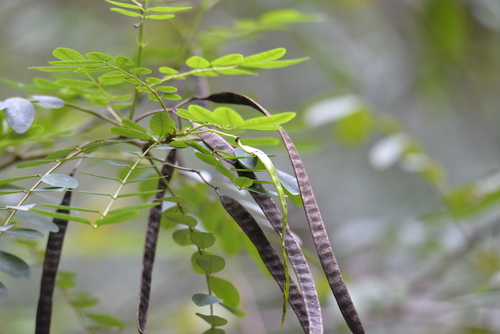
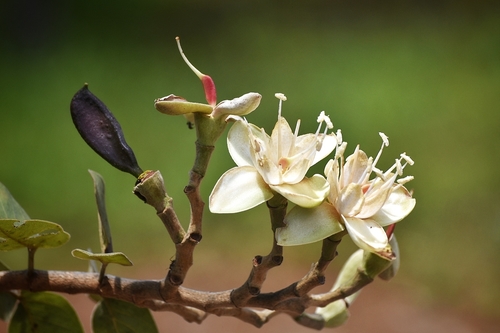
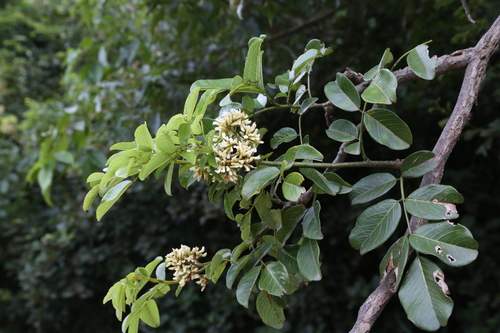
Dalbergia obovata E.Mey. grows as a canopy climber reaching up to 30 m tall in the wild, or as a small tree reaching up to 6 m tall. It has modified tendril-like branches that let it support itself on nearby surrounding vegetation. Its leaves are compound with alternate leaflets; the leaf surface is glossy green on the upper side and blue-grey on the underside, with wavy margins. Whitish, fragrant sweetly scented flowers grow in dense heads at the leaf axils and the tips of branchlets. The fruits are flattened pale yellow to brown pods that grow in clusters, and each pod holds 1 to 3 seeds. This species grows preferentially in coastal and riverine forests, forest margins, wooded slopes, and deciduous woodland. Its distribution ranges from the Eastern Cape, through KwaZulu-Natal and Mozambique, to Tanzania. In Maputaland, the stems are used to make traditional woven hut walls and fishing baskets. Its heavy reddish wood is used for crafting sticks and stools. A root infusion is used to treat stomach ache and toothache, and roots are used to make Zulu love charms. Bark is used to treat sore mouths in babies and to make rope twine; ash from burnt bark is added to snuff. Dalbergia obovata is also planted as a garden plant for its showy flowers, and can be grown to form an impenetrable hedge. Its leaves can be used as feed for livestock.