About Dalbergia melanoxylon Guill. & Perr.
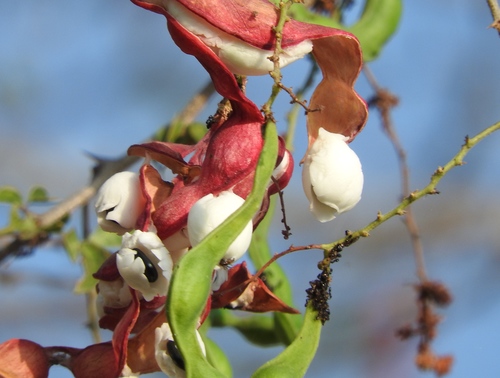
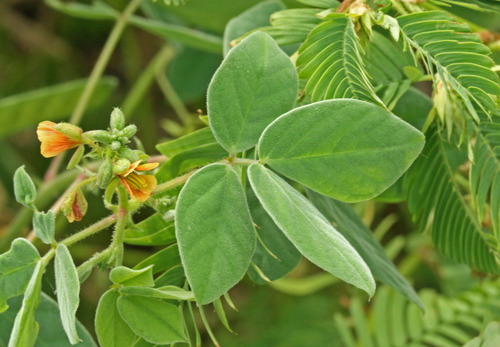
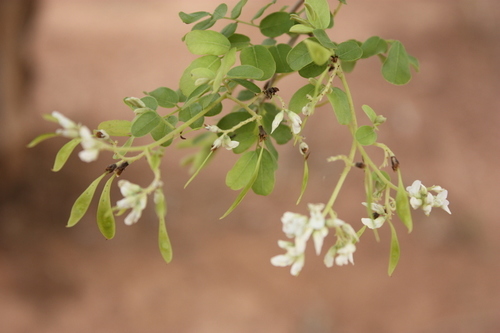
Dalbergia melanoxylon, commonly called African blackwood, grenadilla, or mpingo, and known as Grenadille d'Afrique in French, is a flowering plant in the Faboideae subfamily of the legume family Fabaceae. It is native to seasonally dry African regions, ranging from Senegal east to Eritrea, south through southern Tanzania and Mozambique to northeastern South Africa. This is a small tree that grows 4–15 meters tall, with grey bark and spiny shoots. Its leaves are deciduous during the dry season, alternate, pinnately compound, 6–22 cm long, and carry 6–9 alternately arranged leaflets. It produces white flowers in dense clusters, and its fruit is a 3–7 cm long pod that holds one to two seeds. African blackwood is an important timber species in its native range, and is often cited as one of the most expensive woods in the world, alongside sandalwood, pink ivory, agarwood, and ebony. Its dense, lustrous wood ranges in color from reddish to pure black, with a sharply demarcated bright yellow-white sapwood. It is typically cut into small billets or logs, and the sapwood is left attached to help with slow drying and prevent cracking. High-quality A grade African blackwood commands very high prices on commercial timber markets. The timber is prized for its good machinability, high density, dimensional stability, and moisture repellence. It is most widely used to make musical instruments, including woodwinds such as clarinets, oboes, transverse flutes, piccolos, and recorders, as well as Highland pipes and Northumbrian pipes. The Deering Banjo Company uses this wood, called grenadilla by the company, to make the tone ring for its John Hartford model banjo: the wood is lighter than brass or bronze tone rings, and improves in tone as it is used. Furniture makers have valued this timber since ancient Egypt. There is an anecdotal account that African blackwood was once used as ballast on trading ships, and that enterprising Northumbrian pipe makers made successful use of discarded old blackwood ballast. German knife brands Wüsthof, Böker, and J. A. Henckels sell knives with African blackwood handles, taking advantage of the wood's moisture repellent properties. In Swahili culture, the wood is carved into traditional sculptures called vinyago, and it is also used to make fine furniture. In woodturning, this wood can hold a fine edge without splintering thanks to its hardness and density, though it dulls cutting tools much faster than most other woods. It also releases a sweet, rose-like aroma while being turned. In parts of the species' native range, populations and genomic resources for maintaining genetic biodiversity are threatened by overharvesting, driven by poor or non-existent conservation planning, and by the species' naturally low germination rates. The species matures very slowly, taking up to 60 years to reach harvestable size. Trees are currently harvested at an unsustainable rate, in part due to illegal smuggling of the wood into Kenya. Currently, the mpingo tree is severely threatened in Kenya, and needs increased conservation attention in Tanzania and Mozambique.