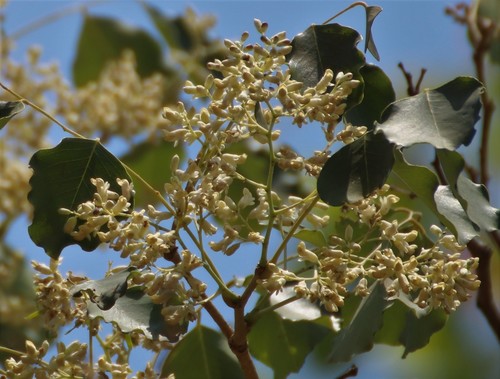
About Dalbergia latifolia Roxb.
Dalbergia latifolia Roxb. is a tree with grey bark that peels in long fibres, pinnately compound leaves, and clusters of small white flowers. It can grow as either an evergreen or a deciduous tree in the deciduous monsoon forests of India, which makes it very tolerant of drought. The fungus Haematonectria haematococca is a pest of this tree, and it causes damage to the tree’s leaves and heartwood in Javanese plantations. In India, trees can sustain serious damage from a species in the Phytophthora genus, a group of water molds. Germplasm resources for Dalbergia latifolia are preserved by the Kerala Forest Research Institute located in Thrissur, Kerala, India. The tree produces wood that is hard, durable, and heavy. When properly cured, this wood remains durable and resistant to rot and insect damage. It is grown as a plantation timber in India and Java, typically in dense, single-species stands, to produce the highly desirable long straight bole that the species is known for. Wood from Dalbergia latifolia is used to make premium furniture and cabinetry, guitar bodies and fretboards, exotic veneers, carvings, boats, and skis, and the tree is also used for reforestation. Under the Indian Forest Act of 1927, it is illegal to export lumber products harvested from wild Dalbergia latifolia. There is high international demand for this wood, and it commands a high price, due to its valuable qualities: a long straight bole, strength, and high density. However, the tree grows slowly. Javanese plantations of Dalbergia latifolia were first established in the late nineteenth century, but due to its slow growth rate, plantations have not expanded beyond Java and India. Many formerly common uses of Dalbergia latifolia wood have now been replaced with Dalbergia sissoo wood and engineered rosewoods for economic reasons in cottage industries.