About Daedaleopsis confragosa (Bolton) J.Schröt.
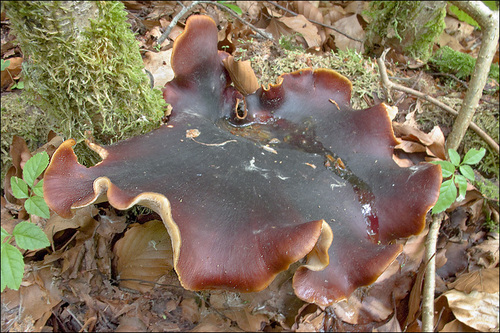
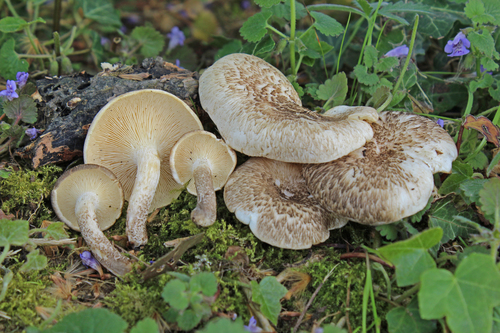
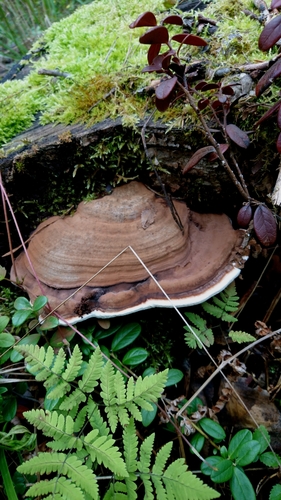
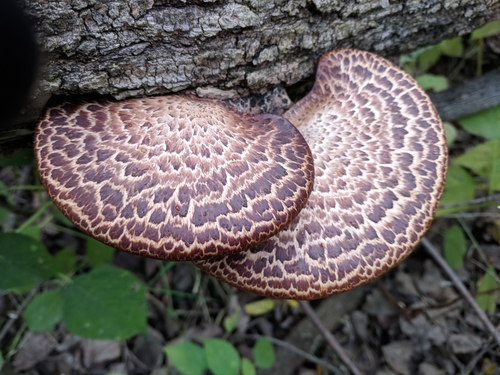
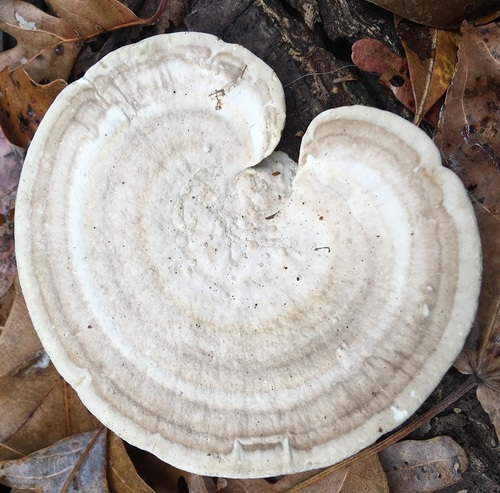
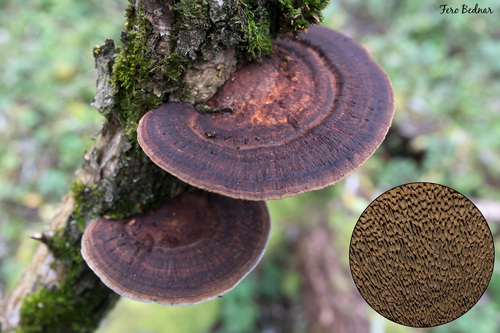
Daedaleopsis confragosa (Bolton) J.Schröt. produces shelf- or bracket-shaped, fan to semicircular fruit bodies that typically measure 5–15 cm (2–6 in) in diameter and grow up to 2 cm (0.8 in) thick. The upper surface of the fruit body is broadly convex to flat, dry, and ranges from smooth to somewhat hairy, and usually marked with concentric zone lines. Its color spans reddish brown, brown, and grayish, and sometimes turns blackish when the fruit body matures. The cap surface may have an umbo at the point where it attaches to its growing substrate. When moist, fruit bodies are leathery to corky, and they become hard and rigid when dry. The flesh is tough, and ranges in color from white to pinkish to brownish. The underside of the fruit body has tiny pores, 0.5–1.5 mm in diameter. Pore color ranges from white to tan to brown, and develops pinkish or reddish tones when bruised. Pore shape is highly variable, and can be circular, elongated, mazelike, or gill-like. The pore tubes grow up to 1.5 cm (0.6 in) long. The fruit body attaches directly to the substrate and has no stalk. Fruit bodies have no distinctive odor, and have a slightly bitter taste. This species produces a white spore print; its spores are cylindrical, smooth, and measure 7–11 by 2–3 μm. Its spore-bearing basidia range from cylindrical to club-shaped, and measure 20–40 by 3–5 μm. The hymenium contains numerous modified terminal hyphae called hyphidia, which measure 2–3 μm. The hyphal system of Daedaleopsis confragosa is trimitic, meaning the fruit body has three distinct types of hyphae: thick-walled skeletal hyphae that provide structural support, measuring 3–7 μm in diameter; generative hyphae that produce new growth, which may be thin- or thick-walled, may have clamps, and measure 2–6 μm; and thick-walled, highly branched binding hyphae that measure 2–5 μm. Daedaleopsis confragosa is a lignicolous (wood-dwelling) fungus that decays sapwood, causing white rot — a type of wood decay where lignin is broken down, leaving cellulose as a light-colored residue. Its fruit bodies grow singly, in groups, or sometimes in tiers, on the wounds of living trees. It prefers willow as a host, but has also been found growing on birch and other hardwoods. Fruiting usually occurs between June and December, though the hard fruit bodies can persist year-round. In North America, the species is most common in eastern areas, but rare in western regions. It is common in Europe, and is counted among the 100 most common fungi in the United Kingdom. Its European range extends east to the Ural Mountains. It is widely distributed across Asia, and has been recorded in China, western Maharashtra (India), Iran, and Japan. Fruit bodies of Daedaleopsis confragosa are commonly used by fungus-preferring beetles. A Russian study recorded 54 beetle species from 16 families that use this fungus; the most common species were Cis comptus, Sillcacis affinis (family Ciidae), Tritoma subbasalis, Dacne bipustulata (family Erotylidae), Mycetophagus multipunctatus, M. piceus (family Mycetophagidae), and Thymalus oblongus (family Trogossitidae). This polypore species is used to make ornamental paper: fruit bodies are pulped, pressed, and dried to produce paper sheets with unique textures and colors. Daedaleopsis confragosa is inedible.