About Dactylortyx thoracicus (Gambel, 1848)
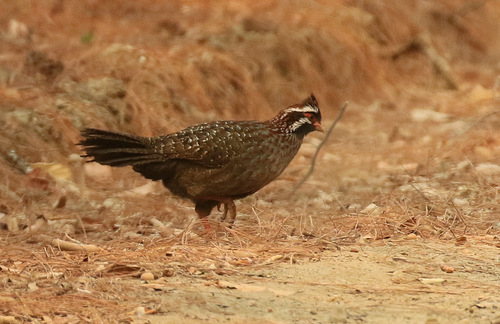
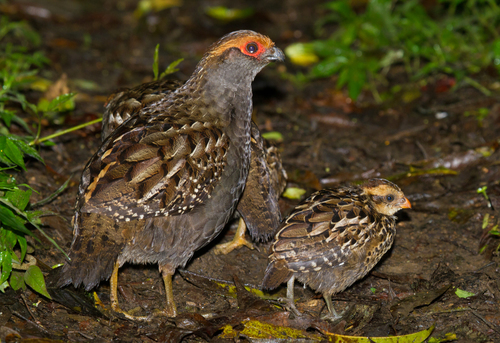
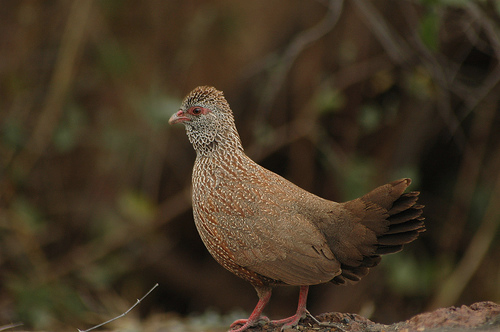
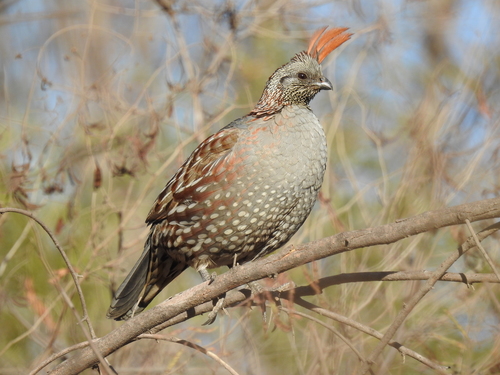
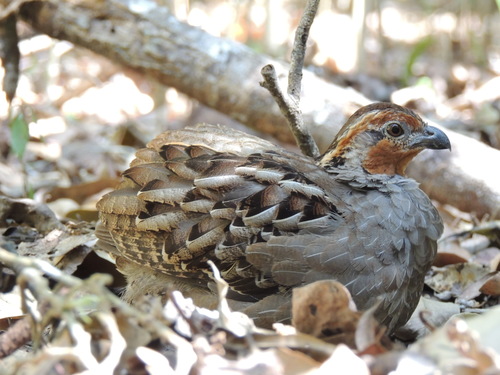
Scientific name: Dactylortyx thoracicus (Gambel, 1848). Description. The singing quail measures 20 to 23 cm (7.9 to 9.1 in) in length. Males weigh 180 to 266 g (6.3 to 9.4 oz), while females weigh 115 to 206 g (4.1 to 7.3 oz). The smallest individuals of the species live near sea level, and the largest live in the mountains. Adult males of the nominate subspecies have a dark brown crown, a buff and black "collar", and a tawny orange face marked with a black streak behind the eye. Their back and wings are mottled gray and brown with thin white streaks; their rump is olive brown or gray, with black vermiculation. Their breast and belly are grayish brown with white streaks, and the lower belly is white. Females have a gray face and white throat, and their breast and flanks are paler brown. Juveniles are similar to females, but have blackish spots on their underparts. There is extensive variation among the other recognized subspecies, but in general, subspecies found in mountain forests are darker than those found in drier lowland areas. Distribution and habitat. The singing quail occurs across several separate areas: northern, western, and southern Mexico, the Yucatán Peninsula, northern Belize, most of Guatemala, and scattered locations in El Salvador and Honduras. In general, the species lives on the floor of forests that have sparse undergrowth. It can also be found in older secondary forest, at the edges of old-growth forest, in clear cuts, and in coffee plantations. The forest types it occupies include subtropical montane forest and cloudforest. Its elevation range extends from sea level to at least 3,000 m (9,800 ft).