About Dactylorhiza viridis (L.) R.M.Bateman, Pridgeon & M.W.Chase
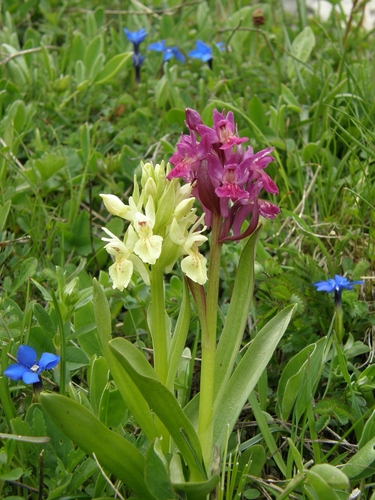
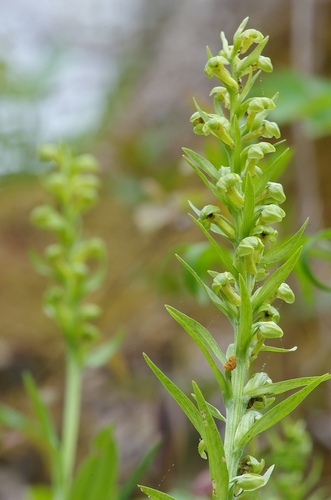
This orchid species grows from fleshy, forked roots, and reaches a total height of 10 to 55 cm (3.9 to 22 inches). Individual plants bear 2 to 6 alternate leaves, which measure 5–14 cm (2.0–5.5 inches) long and 2–7 cm (0.8–2.8 inches) wide. Basal leaves are obovate to elliptical in shape, while leaves positioned higher on the stem are lanceolate. Its inflorescence is a dense, spike-like raceme that holds 7 to 70 small flowers. The flowers are primarily greenish, and often tinged with purple, reddish, or red-brown. Each flower is subtended by a conspicuous long, tapering bract 1–6 cm (0.4–2 inches) long; lower bracts are longer, and typically greatly exceed the length of the flower they subtend. The oval sepals have little to no pointed tip, measure 3–7 mm long and 2–4 mm wide, and are dark green. Sepals join with the petals to form a hood opposite the flower’s lower petal, called the labellum. The petals are long and narrow, 3.5–5 mm long and roughly 0.5 mm wide, and curve inwards. The labellum is strap-shaped, and usually split at its very tip into two or three tooth-like divisions, with the middle tooth smaller than the other two. It measures 5–11 mm long and 1–4 mm wide. A 2–3 mm long nectar spur extends out behind the labellum. Dactylorhiza viridis blooms in late May and early June. It can be pollinated by bees and small wasps, or reproduce autogamously via incoherent pollinia: the pollinia crumble, and some pollen falls onto the flower’s stigma to fertilize it. In North America, this species can be confused with Platanthera flava, the pale green orchid, but it can be easily distinguished by its labellum, which is notched at the apex and lacks the tubercle found on P. flava’s labellum. Dactylorhiza viridis has a broad distribution across cooler regions of the Northern Hemisphere, including most of Europe, non-tropical areas of Asia (such as Russia, Japan, China, and the upper Himalayas, among others), most of Canada, and parts of the United States (Alaska, the Northeast, the Appalachians, the Great Lakes Region, the Northern Great Plains, and the Rocky Mountains). It most often grows in moist, rich soil in wet meadows, moist or wet deciduous woods and thickets, and is frequently found growing on steep slopes. Ecologically, Dactylorhiza viridis is mainly pollinated by beetles and a wide variety of Hymenoptera, including ants. This orchid can form symbiotic relationships with a range of fungi, including Ceratobasidium sp., Epulorhiza anaticulata, Moniliopsis anomala, Rhizoctonia sp., Tulasnella cucumeris, and Tulasnella calospora.