About Dactylorhiza majalis subsp. lapponica (Laest. ex Hartm.) H.Sund.
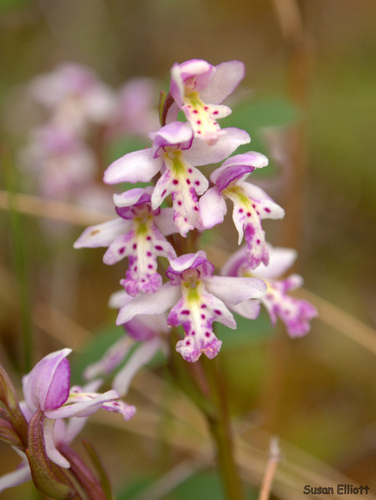
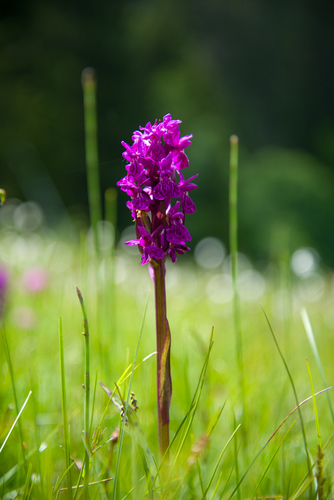
Dactylorhiza majalis subsp. lapponica is a subspecies of Dactylorhiza majalis, commonly known as the broad-leaved marsh orchid. On average, Dactylorhiza majalis grows 15 to 40 cm (6 to 15½ inches) tall, though individual specimens can reach up to 60 cm (2.0 ft) in height. It has a hollow stem, with 4 to 10 spotted purple or burgundy leaves arranged around the stem. Leaves range from ovate to lanceolate in shape, measuring 6 to 18 cm (2½ to 7 inches) long and 1.5 to 3.5 cm (½ to 1½ inches) wide. Leaves become smaller and more distinctly lanceolate as they grow closer to the inflorescence. Bracts are approximately the same length as the flower buds, and completely cover the blossoms before they open. The densely flowered inflorescence is roughly 5 to 15 cm (2 to 6 inches) long; it starts out conical in shape, and becomes distinctly cylindrical once it is in full bloom. A single inflorescence holds 7 to 50 blossoms, which are typically purplish red, and rarely light pink or white. The lateral tepals of the outer perianth circle grow positioned obliquely or straight vertically upright. These lateral tepals are 7 to 12 mm (¼ to ½ inch) long and 2.5 to 5 mm (⅛ to 3⁄16 inch) wide. The middle tepal is smaller, and forms a "helmet" alongside the two inner circle lateral tepals. All three of these tepals are 6 to 11 mm (¼ to 7⁄16 inch) long. The trilobate lip of the flower is 5 to 10 mm (3⁄16 to ⅜ inch) long and 7 to 14 mm (¼ to 9⁄16 inch) wide. The shape and patterning of the lip are variable. Markings in the lighter central area of the lip can appear as lines, streaks, or dots. The spur curves slightly downwards, and is slightly shorter than the ovary. The orchid's tuber is palmately divided and has an irregular shape. The broad-leaved marsh orchid has a karyotype of four sets of twenty chromosomes (2n = 4x = 80), with a genome size of 14.24 Gbp (2C). Orchid seeds do not contain endosperm to support the embryo, so germination can only occur if the seed is infected by a symbiotic root mycorrhizal fungus. Dactylorhiza majalis is widespread across most of Europe and north-central Asia, ranging from Spain and Ireland east to Siberia and Kazakhstan. In Germany, the broad-leaved marsh orchid is widespread across the country but has several gaps in its distribution; it is already extinct in many areas, especially from western to northern Germany. In Switzerland, it is also fairly widespread, with a notable distribution gap south of the Aar river, between Aarau and Lake Neuchâtel.