About Dactylorhiza majalis (Rchb.) P.F.Hunt & Summerh.
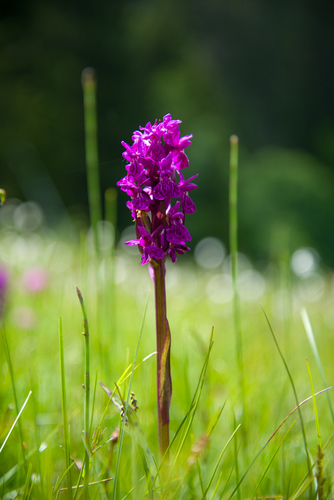
Dactylorhiza majalis (Rchb.) P.F.Hunt & Summerh., commonly called the broad-leaved marsh orchid, has an average height of 15 to 40 cm (6 to 15+1⁄2 in), though individual plants can reach up to 60 cm (2.0 ft) tall. It has a hollow stem surrounded by 4 to 10 spotted leaves, which are colored purple or burgundy. These leaves range in shape from ovate to lanceolate, and measure 6 to 18 cm (2+1⁄2 to 7 in) long by 1.5 to 3.5 cm (1⁄2 to 1+1⁄2 in) wide; leaves become smaller and more distinctly lanceolate closer to the inflorescence. Its bracts are roughly the same length as the flower, and cover the blossom before it opens. The dense inflorescence is around 5 to 15 cm (2 to 6 in) long; it is conical when young, and becomes distinctly cylindrical when fully bloomed. Each inflorescence holds 7 to 50 blossoms, which are most often purplish red, and rarely light pink or white. The lateral tepals of the perianth's outer circle stand obliquely or vertically upright, measuring 7 to 12 mm (1⁄4 to 1⁄2 in) long and 2.5 to 5 mm (1⁄8 to 3⁄16 in) wide. The middle tepal is smaller, and forms a "helmet" with the two lateral tepals of the inner perianth circle; these inner tepals are 6 to 11 mm (1⁄4 to 7⁄16 in) long. The trilobate lip of the flower is 5 to 10 mm (3⁄16 to 3⁄8 in) long and 7 to 14 mm (1⁄4 to 9⁄16 in) wide, with variable shape and patterning. Markings in the lighter central area of the lip consist of lines, streaks, or dots. The spur curves slightly downward and is slightly shorter than the ovary. This orchid has an irregularly shaped palmately divided tuber. The broad-leaved marsh orchid has a karyotype of four sets of twenty chromosomes (2n = 4x = 80), with a genome size of 14.24 Gbp (2C). Its seeds do not contain endosperm to support the embryo, so germination can only occur when the seed is infected by a root-inhabiting mycorrhizal fungus. Dactylorhiza majalis is widespread across much of Europe and north-central Asia, ranging from Spain and Ireland east to Siberia and Kazakhstan. In Germany, the species is widespread but has multiple distribution gaps, and is extinct in many areas, particularly from western to northern Germany. In Switzerland, it is also fairly widespread, with a large distribution gap south of the Aar river between Aarau and Lake Neuchâtel.