About Dactylis glomerata L.
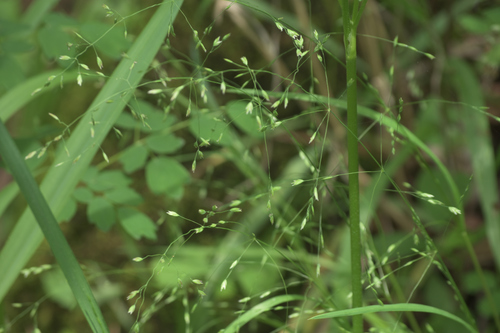
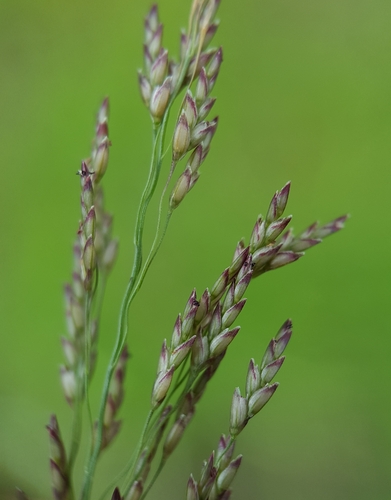
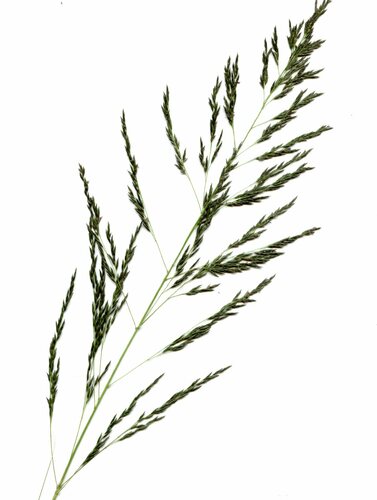
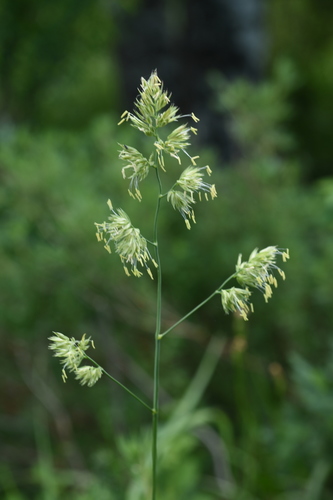
Dactylis glomerata, commonly called cock's-foot, is a perennial grass that grows in dense tussocks. It reaches 20 to 140 centimetres (0.66 to 4.59 feet, 7.9 to 55.1 inches) in height, with grey-green leaves that are 20 to 50 centimetres (0.66 to 1.64 feet, 7.9 to 19.7 inches) long and up to 1.5 centimetres (0.59 inches) broad. It has a distinctive tufted triangular flowerhead measuring 10 to 50 centimetres (0.33 to 1.64 feet, 3.9 to 19.7 inches) long, which may be green or tinged red to purple—usually green in shade and redder in full sun—and turns pale grey-brown when seeds reach maturity. Its spikelets are 5 to 9 millimetres (0.20 to 0.35 inches) long, and typically hold two to five flowers. It can be distinguished from many other grasses by its characteristic flattened stem base, and it flowers from June to September. For its distribution, Dactylis glomerata grows from sea level in the northern part of its range, up to 4,000 metres in elevation in the southern part of its range in Pakistan. It is a principal species of the widespread United Kingdom National Vegetation Classification habitat community MG1, Arrhenatherum elatius grassland, so it often occurs alongside Arrhenatherum elatius, also called false oat grass. It can be found growing in meadows, pastures, roadsides, and rough grassland. It has been introduced to North America, New Zealand, and Australia, where it is now widely naturalized, and it has become an invasive species in some areas. Regarding cultivation and uses, cock's-foot is widely used as a hay grass and for pastures due to its high yields and sugar content, which makes it sweeter than most other temperate grasses. In dry regions such as much of Australia, Mediterranean subspecies like subsp. hispanica are preferred for their better drought tolerance. This grass requires careful grazing management; if it is undergrazed, it becomes coarse and unpalatable. In some introduced regions, notably parts of the eastern United States, it has become an invasive weed. Like other grasses, its pollen can cause allergic rhinitis (hay fever) in susceptible people. It is commonly grown to satisfy domestic cats' craving to chew grass, which gives it the colloquial name cat grass. Its seeds were first collected by Rogers Parker in Hertfordshire, then developed by agricultural reformer Coke of Norfolk. Parker's estate, Munden near Bricket Wood, was later inherited by botanist George Hibbert.