About Daceton armigerum (Latreille, 1802)
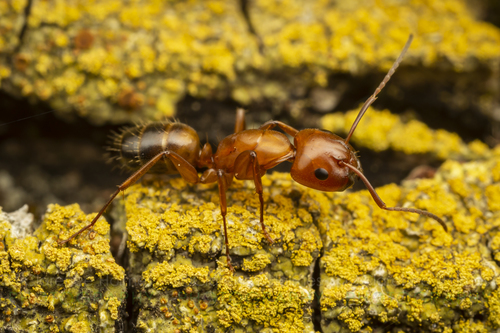
Daceton armigerum has a complex, continuously polymorphic caste system among workers: smaller workers nurse the brood, while larger workers hunt, dismember prey, and defend the nest. Workers have trap-jaw, hypertrophied mandibles that snap together when triggered by sensory hairs on the labrum, producing a lethal bite. The worker caste shows dramatic polymorphism with a unimodal size-frequency distribution, called monophasic allometry; foraging workers, which are themselves highly polymorphic, are larger than workers that stay inside the colony. Workers are so well adapted to arboreal life that if they fall from the forest canopy, they can glide back down to the trunk of their host tree. This species is distributed across northern South America, and occurs in terra firma and flooded forests of Bolivia, Brazil, Colombia, Ecuador, French Guiana, Guyana, Peru, Suriname, Trinidad, and Venezuela. D. armigerum typically nests in tree branch and trunk cavities previously bored by beetles and other insects. Its colonies are polygynic (having multiple queens) and polydomous (having multiple nests), and can reach approximately 952,000 individuals, which is far larger than the earlier estimate of 10,000 workers suggested by Wilson (1962). Colonies likely contain multiple egg-laying queens, because none of the queens observed in one study had wing stubs. In many ant species, unmated females that stay in or return to the nest lose their wings piece by piece, leaving stubs. In contrast, after a nuptial flight, mated queens use their hind legs to tear off their wings along a pre-existing line of weakness at the base of the wings, leaving a clean tear that is generally taken as a sign the queen has mated. D. armigerum workers shelter in small chambers located at the end of their host tree's branches, which resembles the "barracks" leaf nests built by Oecophylla beyond the species' territory boundaries that hold only older workers.