About Cytisus striatus (Hill) Rothm.
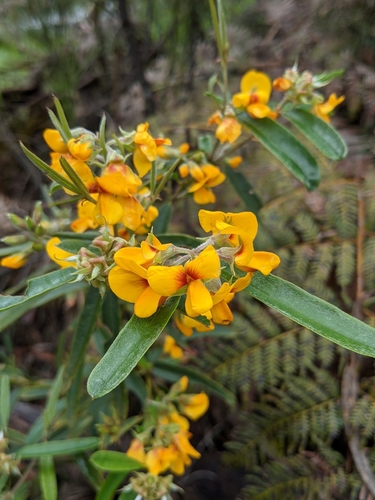
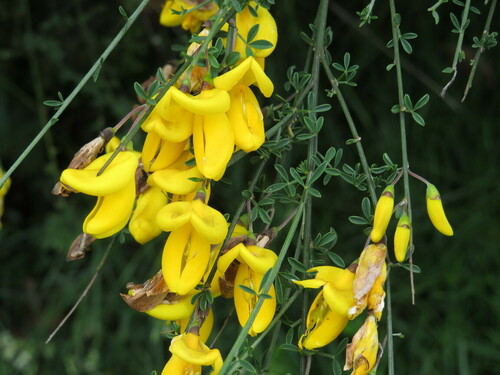
This tall, bushy, highly branched sprawling shrub often exceeds 2 meters in height, and can reach 2 to 3 meters tall. It has green, photosynthetic stems marked with 8 to 10 longitudinal ridges. Its sparse leaves may be trifoliate or simple, deciduous or evergreen depending on climate, and are composed of small leaflets each around 1 centimeter long. The shrub produces yellow pea-shaped legume flowers that grow singly or in pairs along its stems. Its fruit is a slightly inflated, densely hairy legume pod covered in white hairs, which explosively releases seeds when mature. The plant's seeds can also be spread by ants. This species is very similar to its relative Cytisus scoparius, but can be distinguished by its paler yellow flowers and the hairy covering on its pods.
Native to Portugal and Spain, Cytisus striatus extends into northern Morocco, where it grows as part of local shrubland ecosystems called giestais. It typically grows in acidic, nutrient-poor soils formed from granite, schist, or quartzite. It is commonly found along roadsides, on open hillsides, in forest clearings, fallow lands, and rocky slopes, most often at elevations up to 1,200 meters. In Portugal, this species becomes a dominant component of secondary vegetation communities after deforestation or fire disturbance. Its rapid germination, nitrogen-fixing ability, and high seed output let it colonize disturbed soils very efficiently. In North America, it occurs mostly in California and Oregon, where it behaves ecologically like Cytisus scoparius, forming dense monocultures that alter soil composition and fire dynamics. Thanks to its adaptability and nitrogen-fixing ability, it can dominate disturbed habitats and rapidly colonize open areas. The California Department of Food and Agriculture (CDFA) lists brooms as Class C pest species, while the California Exotic Plant Pest Council (CalEPPC) categorizes both Scotch broom (Cytisus scoparius) and Portuguese broom (Cytisus striatus) as List A invasive species, a classification that reflects their aggressive spread and ecological impact.
As a member of the Fabaceae family, Cytisus striatus forms symbiotic root nodules with Bradyrhizobium species that allow it to fix atmospheric nitrogen. This process improves soil fertility in poor or eroded areas. Soils under this shrub usually hold higher concentrations of organic matter, nitrogen, and phosphorus than soils in adjacent open areas. While Cytisus striatus increases local soil nutrient levels, it reduces herbaceous species richness and diversity through shading and competition. The shrub's dense canopy lowers understory herb diversity by creating shaded, nutrient-rich microsites that are often dominated by grasses from the Poaceae and Asteraceae families. Despite this local suppression of other plants, the patchy distribution created by Cytisus striatus clumps increases overall landscape diversity. Physiological studies show this species can switch between atmospheric nitrogen fixation and uptake of inorganic nitrogen, depending on phosphorus availability and soil fertility. This flexibility gives it a competitive advantage in low-nutrient environments, allowing it to continue growing under difficult conditions. Cytisus striatus produces higher biomass at a low carbon cost, and maintains effective nitrogen fixation even when resources are limited, which helps it thrive in degraded or acidic habitats. Additionally, this species shapes local fire ecology by accumulating large amounts of combustible litter, which promotes high-intensity wildfires that further favor its own regeneration. Its extensive root system and resprouting ability allow it to recover quickly after fire, reinforcing its dominance in frequently disturbed landscapes.
Historically, Portuguese broom was used for thatching, making brooms, as animal fodder, and as a soil improver, thanks to its nitrogen-fixing capabilities. Its flowers have been used in folk medicine to treat rheumatism, gout, hypotension, and liver disorders. In modern research, the species has been tested for phytoremediation, particularly for soils contaminated with hexachlorocyclohexane (HCH) isomers. When inoculated with specific rhizobacterial strains, Cytisus striatus showed enhanced growth and increased pollutant degradation, indicating potential for use in environmental cleanup projects.