About Cytisus oromediterraneus Rivas Mart. et al.
Cytisus oromediterraneus is a shrub species made up of dense, tightly packed branches. It forms extensive shrublands, growing either alone or alongside other shrubs. For example, it grows with creeping juniper (Juniperus communis subsp. nana) in high siliceous mountains, and it almost always grows above the forest tree line or alongside Scots pines.
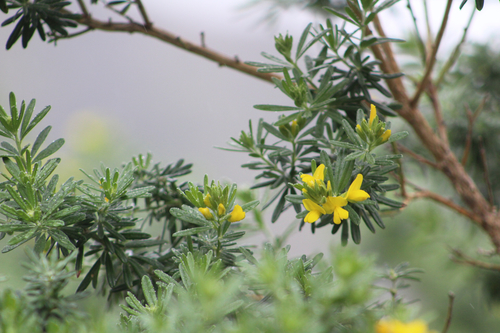
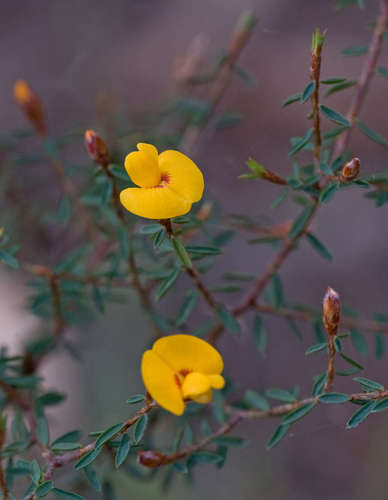
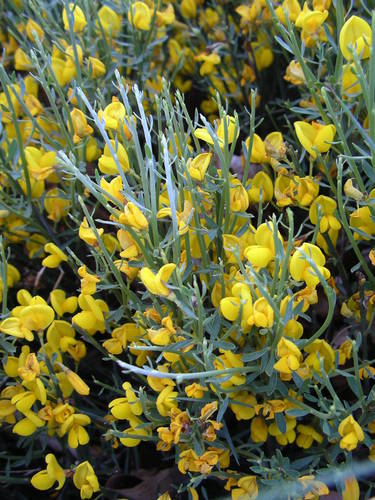
Its leaves drop early, so its stems are often bare. Lower leaves are trifoliate and lack a petiole, while leaves located near flowers are simple and also stalkless. Its small yellow flowers measure 9–12 mm, and grow singly or in pairs in leaf axils. They form a more or less dense cluster at the end of branches, supported by a 2–6 mm floral base. The calyx is membranous, bell-shaped and covered in hairs. The corolla is butterfly-shaped, with a rounded upper petal.
Its fruit is a legume pod 15 to 30 mm long, straight or slightly curved, very laterally compressed and covered with tightly appressed hairs. This species flowers from May to July.
Cytisus oromediterraneus (also called Pyrenean broom) is the dominant vegetation of the oromediterranean zone in the Sierra de Gredos, and can cover the highest north-facing slopes of the supramediterranean zone. Along the road leading to the platform in Gredos, it is easy to observe that north-facing slopes are covered by this species, while south-facing slopes are occupied by hiniesta and/or white broom. In zones where Pyrenean broom and white broom grow together, individuals with very pale yellow flowers can be found; these are interpreted as hybrids between the two species.
In the westernmost sectors of the Central System mountains, two other very thorny shrubby fabaceae, which reach their best growth in the oromediterranean zone alongside Pyrenean broom, can also grow on north-facing supramediterranean slopes: common broom (Echinospartum barnadesii) and Iberian broom (Echinospartum ibericum). Clearings in Cytisus oromediterraneus shrublands (piornales) are mainly occupied by various herbs and shrubs. Notable species found in these clearings include the endemic Echium salmanticum (viborera salmantina, a boraginaceae restricted to the western half of the mountain range), Ortegia hispanica (ortegia, a caryophyllaceae), Lavandula pedunculata (lavender, a lamiaceae), Santolina rosmarinifolia (thyme, an asteraceae), Aster sedifolius (the rice-leaved aster, an asteraceae), and Digitalis thapsi (the pink-flowered foxglove, a plantaginaceae). Most of these species also grow in cleared oak forest understories, and can climb up sunny slopes to reach Pyrenean broom shrublands.
This species is distributed across France, the Iberian Peninsula, and North Africa. Within the Iberian Peninsula, it is very abundant in the Guadarrama Mountains, Sierra de Gredos, Paramera de Ávila, La Serrota, the Iberian System, Montes de León, and the Pyrenees. It also occurs in Galicia, Cantabria, Aragon, Catalonia, Castile, Extremadura, and Andalusia.