About Cystodermella cinnabarina (Alb. & Schwein.) Harmaja
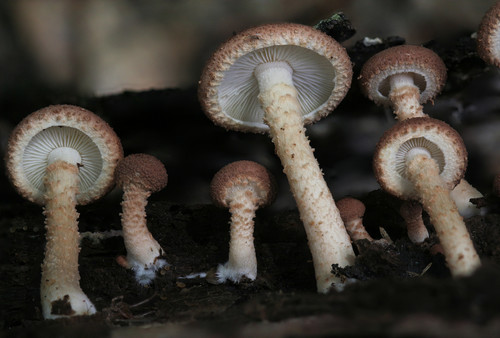
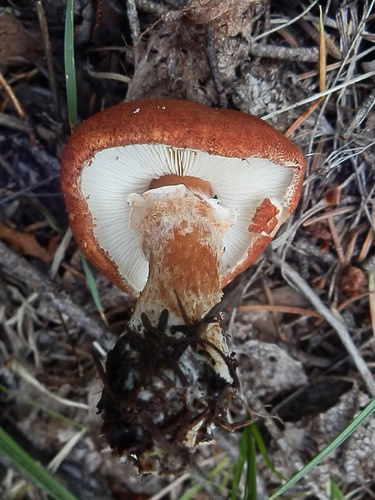
When young, the cap of Cystodermella cinnabarina is hemispherical; as it matures, it becomes convex and eventually flattens out, reaching up to 5.5 cm (2.2 in) across. The cap cuticle ranges in color from cinnabar red and brick red to rusty orange, and is densely covered with fine granules. The flesh is white to pale, with a mild to sweet taste and a mild or mealy scent. The gills are white to cream in color, are closely spaced, and are either emarginate or adnate. Immature specimens have a finely cottony partial veil covering the gills; as the mushroom matures, this veil tears away, leaving a delicate ring on the stem. Above the ring, the stem is white; below the ring, it is covered in dark orange, scale-like structures called squamules. The stem grows up to 6 cm (2.4 in) tall and 1.5 cm (0.6 in) in diameter, and sometimes has a bulbous base and a hollow interior.
For microscopic characteristics, the basidiospores are oval, transparent (hyaline), and non-amyloid, measuring 3.5–5 by 2.5–3.5 μm. The spore print of this species is white. The spore-producing basidia are club-shaped, with dimensions of 17–24 by 4–5 μm. C. cinnabarina consistently has specialized cells called cheilocystidia, which are cystidia located on the edges of the gills; these cells are spear-shaped in this species. This microscopic trait can be used to distinguish it from similarly colored C. adnatifolia and C. granulosa, which also produce non-amyloid spores but do not have cheilocystidia. Unlike C. cinnabarina and other Cystodermella species which have non-amyloid spores, species in the genus Cystoderma (including orange-capped species such as Cystoderma amianthinum) have amyloid spores. This difference is identified via the amyloid staining reaction: all Cystodermella species produce a negative reaction, with spores staying colorless.
Cystodermella cinnabarina produces fruiting bodies in coniferous and deciduous forests, growing on the ground among moss, grass, and leaf litter. It is a saprotrophic fungus, meaning it feeds by decomposing dead organic matter. It has been recorded growing under pine (Pinus nigra, Pinus pinea), oak, spruce (Picea orientalis), fir (Abies cephalonica) and chestnut (Castanea sativa) in Greece and Turkey. Fruiting bodies appear either alone or in small groups during summer and autumn. The species is widely distributed across the globe, with recorded occurrences on the continents of Asia, Africa, Europe, and North America, though it is uncommon in many regions. Cystodermella cinnabarina is listed as Near Threatened under IUCN criteria on the preliminary red data list of threatened British fungi.