About Cystoderma carcharias (Pers.) Fayod
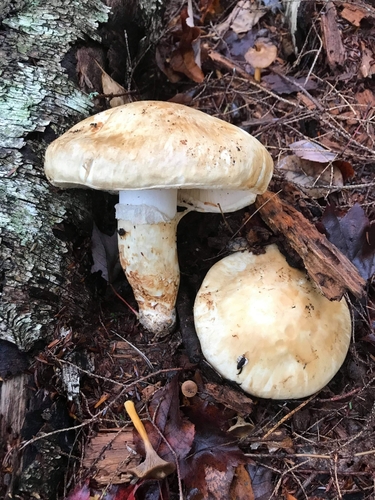
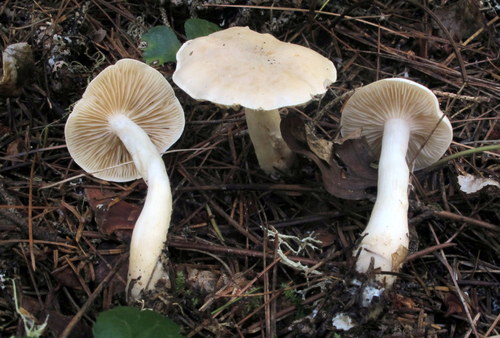
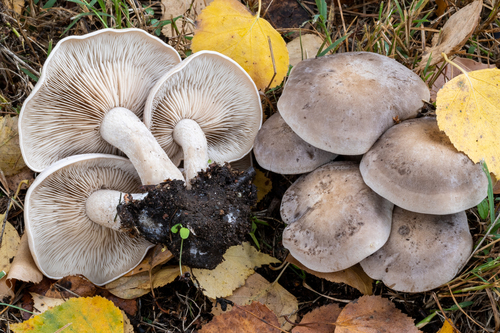
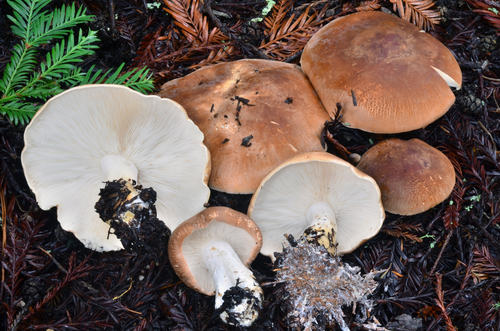
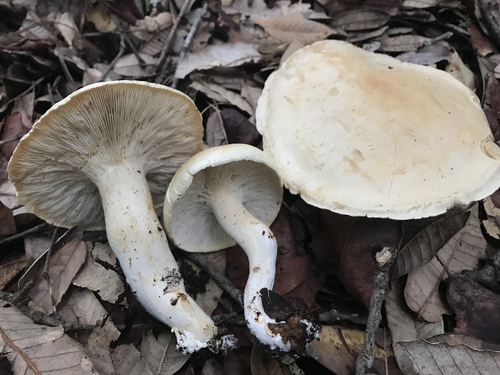
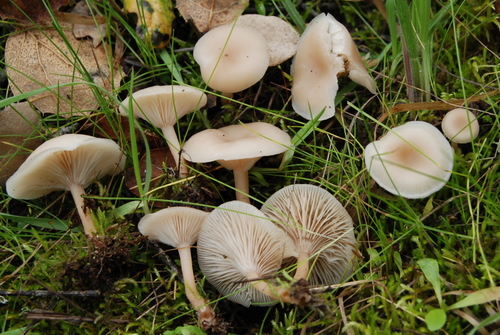
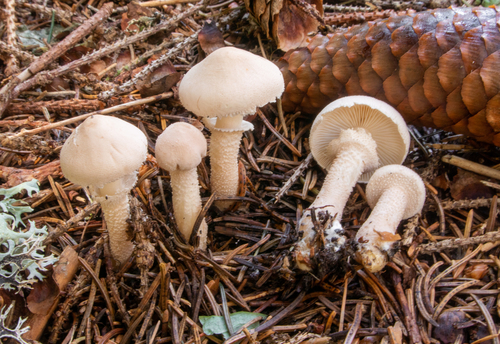
Cystoderma carcharias (Pers.) Fayod produces relatively small agaric fruiting bodies. Its cap is off-white with a pale pink tinge, has a distinct darker central spot and a powdery cuticle. Young caps are convex, while mature caps flatten and develop a slight umbo, reaching up to 6 cm (2.4 in) in diameter; the cap margin is often fringed with remnants of a partial veil. The gills are white, adnate, and crowded. The cylindrical stem grows up to 7 cm (2.8 in) tall; it is white and smooth above a persistent white, upturned, flared ring, and granular below the ring. The flesh is white, firm, and solid throughout. A named form, C. carcharias forma album, is identified by its all-snow-white cap. Under microscopic examination, the spores are ellipsoid, measuring 4–5.5 by 3–4 μm; they are white and amyloid. The 4-spored basidia are club-shaped, and measure 20–25 by 4–6 μm. Fruiting bodies have a characteristic strong, unpleasant odour, which has been described as earthy, muddy, or mouldy by different authors; this odour comes from the compound geosmin. The taste of the fungus is not distinctive. Cystoderma carcharias is a fairly common fungus distributed across Europe, North America, and temperate Asia, and it is also found on the treeless Australian subantarctic Macquarie Island. It is an acidophilic litter saprotroph that typically grows in coniferous forests, most frequently under spruce. Fruiting bodies appear singly or in groups, growing on soil among grass or moss during late summer and autumn. This fungus accumulates cadmium in its fruiting bodies; in polluted areas, cadmium concentrations can exceed 600 mg/kg in dry mass. Intracellular cadmium accumulated in C. carcharias sporocarps is associated with two isoforms of metallothioneins. Cystoderma carcharias also contains multiple organoarsenic compounds; two of these, dimethylarsinoylacetate and trimethylarsoniopropionate, were first reported from the terrestrial environment in this species. Multiple sources have classified Cystoderma carcharias as inedible.