About Cystoderma amianthinum (Scop.) Fayod
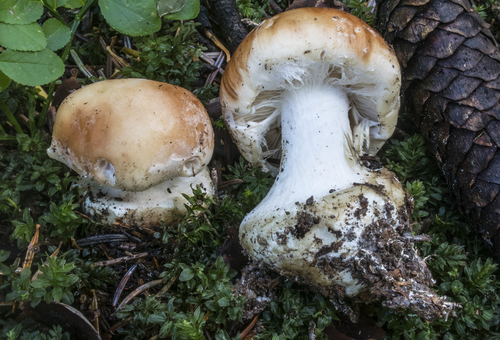
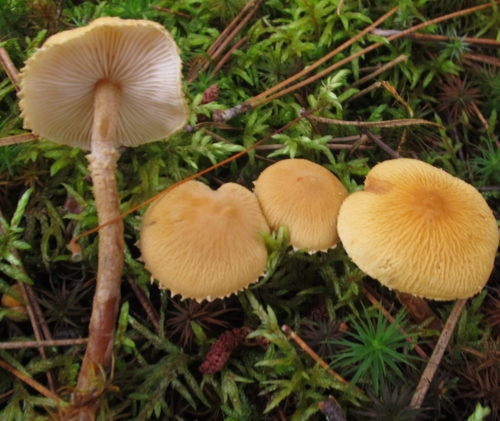
The cap of Cystoderma amianthinum measures 1 to 5 cm (0.5 to 2 inches) in diameter. It starts convex to bell-shaped, and later becomes flat with a slight depression surrounding a low central umbo, or central boss. The cap surface is dry and powdery, often with a shaggy or fringed appendiculate margin, and its color is saffron-yellow or orange-ochre; some forms have a whitish yellow cap. The stem is cylindrical, and features a flaky-granular sheath under a short-lived, powdery ring. The gills are white when young, turning creamy as they mature. They are adnexed, meaning narrowly attached to the stem, and are quite crowded when young. This species produces a white spore print. The flesh is thin and yellowish, with an odor that is either unpleasant, or similar to the scent of husked corn. Some authors have separated a very similar form with a distinctly radially wrinkled cap into its own species, given the binomial Cystoderma rugoso-reticulatum. Compared to Cystoderma amianthinum, the related species Cystodermella granulosa and Cystodermella cinnabarina are generally redder, and have adnate gills that are broadly attached to the stem. Cystoderma amianthinum is widespread across Europe and North America, and common throughout northern temperate zones. It grows in mossy woodland, on heaths, among grass or bracken, and sometimes grows alongside willow. It is often found growing on acidic soils.