About Cyrtophorus verrucosus (Olivier, 1795)
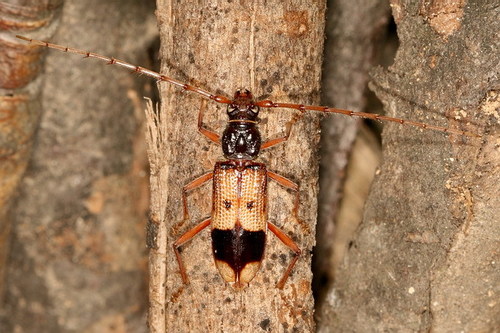
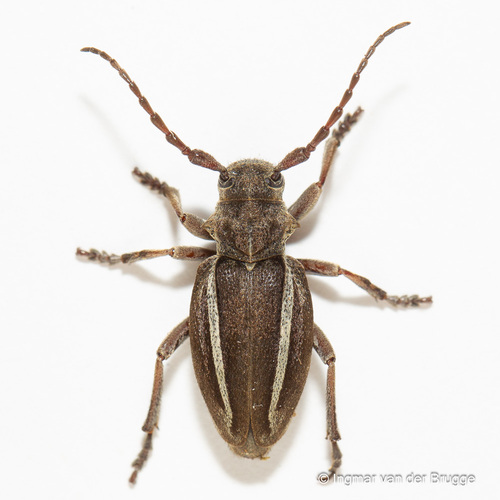
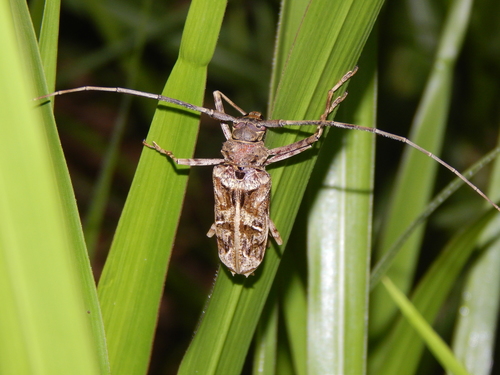
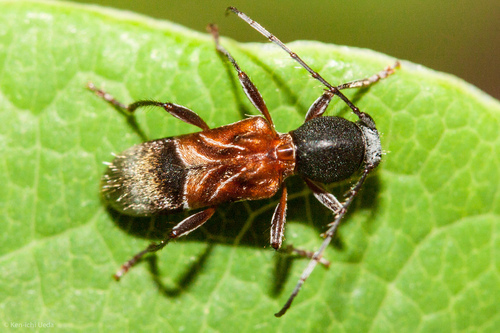
Cyrtophorus verrucosus (Olivier, 1795) is a specialized ant mimic that even moves in a manner similar to ants. It occurs in two forms with varying amounts of red and black patterning; the red form is thought to mimic Camponotus chromaiodes, and the black form is thought to mimic Camponotus pennsylvanicus. Its pronotum has knobs at its base, and two white lines of setae near its center. Adults are typically between 7 mm (0.28 in) and 11 mm (0.43 in) in length.
C. verrucosus has a broad natural geographic range, ranging from deciduous forests in Canada down to tropical regions of Mexico and the West Indies. The size of its occupied range depends on habitat suitability and the availability of deciduous forest. Historically, this species was known to inhabit Ontario's Carolinian Forest region, Great Lakes-St Lawrence region, and limited areas along the north shore of Lake Ontario, Lake Huron, and the Niagara Peninsula. It is widely believed that C. verrucosus has declined in the Ontario region, with recorded data showing a 10% population decline there. Loss of forested habitat from land clearing for development and timber extraction is the likely cause of this decline, and environmental change is identified as the primary driver of species loss in the region. Over 18,000 specimens of C. verrucosus have been collected in Ontario over the last 100 years. There has been a lack of research interest in this species from research institutions in Ontario, and further phenology work is needed to fully understand its current range.
C. verrucosus is found inhabiting forest trees, where it acts as a pest, but also fills an ecological role as a decomposer, contributing to nutrient cycling that maintains ecosystem turnover. This species has been recorded as the most abundant beetle species in a collection of urban forest fragments in Northern Delaware. C. verrucosus has seasonal phenology, and adults abandon temporal habitat isolation to pursue reproduction. To study C. verrucosus species richness and adult phenology, researchers use ethanol-synergized pheromone traps baited with a mix of ethanol and plant volatile from stressed trees. C. verrucosus beetles detect ethanol released by stressed trees and use this cue to locate these trees as hosts, even in the absence of pheromone signals. Researchers are currently collecting pheromones from different C. verrucosus colonies to build a database that can improve future bait blends, with the goal of creating a single multi-species attractant that allows study of a wider range of beetle taxa across different forest types, including temperate deciduous forests and boreal pine and larch forests.
Existing larval host and distribution records provide key information about how C. verrucosus disperses within ecosystems. C. verrucosus is polyphagous; larvae are collected from the dead portions of living trees and shrubs, and from dead stems that stay moist through contact with heavy soil. Larvae have been found in the root transition zone between living and rotting tissue of Shepherdia canadensis, in the lower portions of thick dead stems of Vaccinium corymbosum, and in deer-damaged dead scar tissue of Hamamelis virginiana and Celtis occidentalis. C. verrucosus tends to occupy a small home range, staying near its initial site of infestation. Very little is currently known about territoriality in Cyrtophorus beetles, and no direct evidence of territorial behavior has been found. Many factors likely influence home range size and territorial behavior, including habitat structure, availability of suitable breeding sites, ecological damage, population density, intra- and interspecific competition, and resource availability. In highly competitive environments, C. verrucosus likely competes with other pest-like beetles for pollen and nectar at host plant sites. Many aspects of C. verrucosus ecology, including communication patterns, foraging behaviors, and resource defense, remain unstudied; all of these likely affect territoriality and may help explain how this species establishes distinct home ranges separate from other pollen-seeking beetle species.
This species lives in deciduous forests, and adults are sometimes found on spring flowers, from which they collect pollen and nectar. Their food resource access and consumption are heavily influenced by their geographic distribution and ant mimicry. Their morphological similarities to ants, including matching color patterns and specific physiological adaptations, help them access hardwood plants and spring-flowering host trees. It is unknown whether C. verrucosus engages in cooperative foraging, and the social mechanisms of pollen and nectar collection are not understood. In addition to meeting the beetles' nutritional needs, this feeding behavior means C. verrucosus acts as a pollinator for flowering plants, increasing local plant abundance and diversity, shaping habitat biodiversity, and building overall ecosystem resilience. Its pollination role supports the health of plant-animal interactions, improves habitat connectivity by facilitating plant dispersal, and adds redundancy to pollination interactions that helps plant species colonize fragmented landscapes. Most C. verrucosus depend heavily on tree or shrub hosts for larval growth and development, so changes in host abundance and distribution can alter the species' geographic range. Common known host plants include southern hardwoods like hackberry and hickory, and white pine growing on sandy soil. Larvae develop and feed inside hardwood trees, most commonly in genera that include Acer, Betula, Cercis, Pinus, and Ulmus. They have also been recorded living in wild red cherry, quince, and other temperate forest trees. Adult C. verrucosus are typically active between March and July.