About Cyrtophora citricola (Forsskål, 1775)
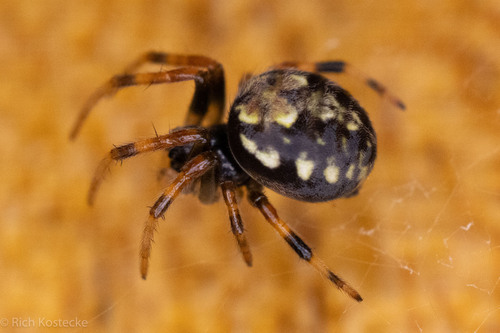
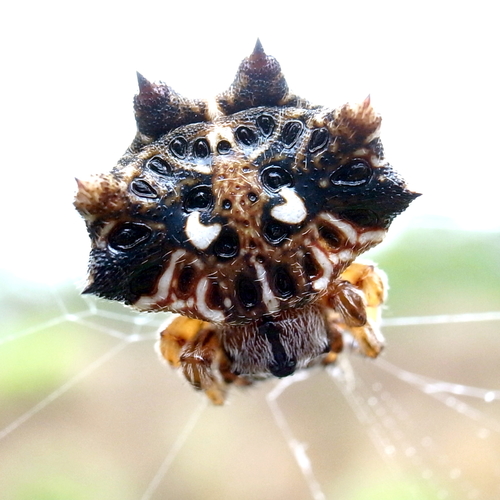
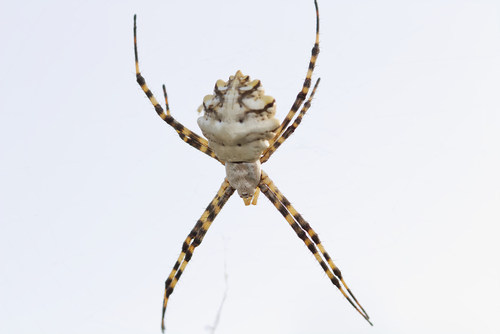
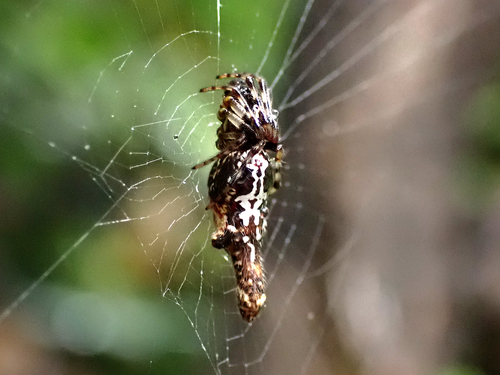
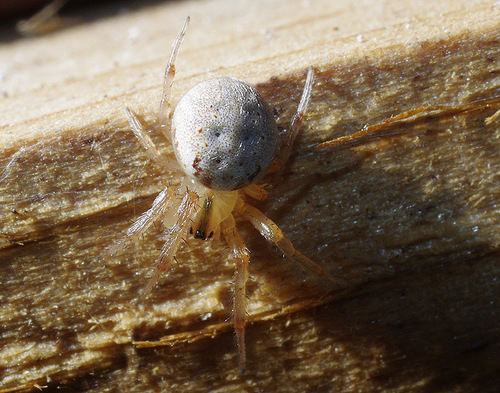
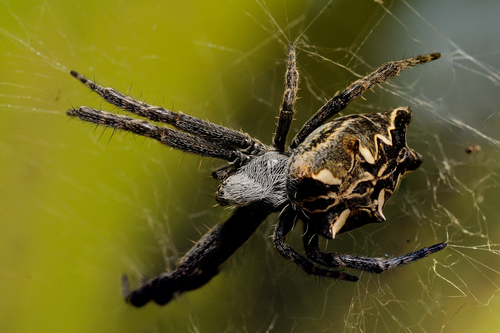
Cyrtophora citricola (Forsskål, 1775) displays a variety of color patterns, and may have differently colored spots on its abdomen. This species is sexually dimorphic: females can grow up to 10 millimetres (0.39 in) long, making them larger than males, which are usually 3 millimetres (0.12 in) long. The legs of C. citricola vary in length, with the first and second pairs being the longest. In Florida, male C. citricola are solid black, while females can change the color of their abdomens to match their surroundings, camouflaging themselves in their webs, and females here have white trichobothria. In Turkey, C. citricola individuals are usually brown and covered in grey hair. C. citricola has a distinct horizontal bifurcation on its posterior abdomen. It differs from related species by having two pairs of dorsal tubercles and one pair of posterior tubercles, and it typically has seven denticles. Its opisthosoma has two dorsal pairs of protuberances and two posterior lobes. The species has two rows of eyes; the two median eyes in the anterior row are the largest. In some locations, C. citricola can be confused with the species Mecynogea lemniscata. C. citricola is distributed across Asia, Africa, Australia, Costa Rica, Hispaniola, Colombia, and Southern Europe. The species cannot survive at temperatures below -1 °C (30.2 °F). It was first discovered in Florida in 2000, where it builds webs on canal bridges from the eastern end of Everglades National Park to Florida's east coast. This spider occupies a wide range of environments, but is most common in olive orchards and undergrowth, and it is also found in tropical agricultural operations. Unlike its close relatives, which are restricted to specific regions, C. citricola can be found across a large global area. Its expanding presence in the Americas has become problematic: it is becoming increasingly common in agricultural and urban areas, damages farm operations, and active removal efforts are underway because its webs are known to damage flora. C. citricola exhibits thermoregulative behavior, a trait shared with other web-building spiders including Nephila clavipes, N. maculata, and Frontinella communis. During the hottest parts of the day, the spider positions its body to expose as little surface area to the sun as possible. C. citricola is active from mid-summer to early fall, and adult individuals mate between June and September. After adult males emerge, they search for female mates. This species has very high rates of sexual cannibalism: females often eat males after mating, and do so after most successful copulations, up to 100% of the time. A male's age and feeding state do not affect whether he will be cannibalized. This high rate of sexual cannibalism makes males choosy when selecting mates: males prefer to mate with younger, well-fed, virgin females. Females are far less choosy about their male mates, though they may prefer well-fed, older males. Around 50% of females re-mate within ten days of their first copulation, and sexual cannibalism enforces monogamy on male C. citricola. The mating process is initiated by the female. Typically, the female approaches the male until she is 1 centimeter away, after which the male moves quickly toward the female and attempts to insert his pedipalp. If this attempt succeeds, copulation begins and lasts for a few seconds. This is the stage at which copulation most often ends in failure. Unlike other cannibalistic spider species, male C. citricola do not somersault into the female's chelicerae. Instead, the female bends her cephalothorax and positions herself to attack the male's abdomen while his pedipalp is inserted inside her. After the male is eaten, his pedipalp detaches from the female.