About Cyrtanthus ventricosus Willd.
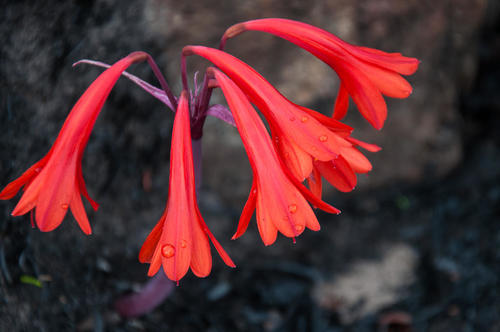
This species, commonly called fire lily, produces tubular pink to bright red flowers, with each tepal bearing a darker stripe running down its center. Flowers grow in an inflorescence that holds 1 to 14 individual flowers; rarely, a single plant will produce two inflorescences. Flowering occurs most frequently between December and May, and only takes place after fires, triggered by exposure to smoke. The flat, black seeds are winged and dispersed by wind. Bulbs produce linear leaves each winter, from June to August, and leaves and flowers are never present at the same time. Ecologically, this plant flowers after wildfires. Its bright red flowers stand out clearly against blackened post-fire terrain to the species’ main pollinators: butterflies and sunbirds. These pollinators are drawn to the nectar the flowers produce. Sunbirds sometimes pierce the base of the flower tube to access nectar without transferring pollen between plants. This species is fully self-sterile, so self-pollinated flowers do not produce viable seeds.