About Cyrestis thyodamas Boisduval, 1836
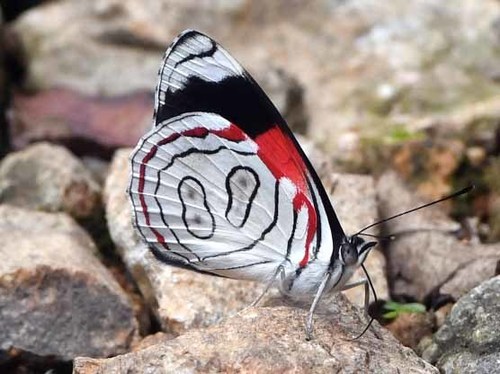
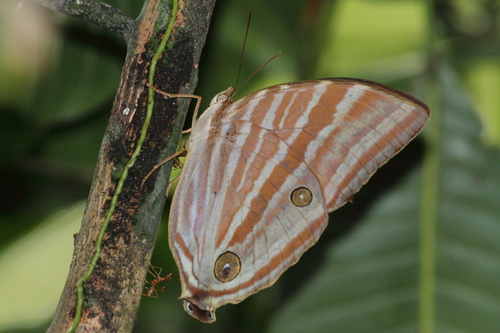
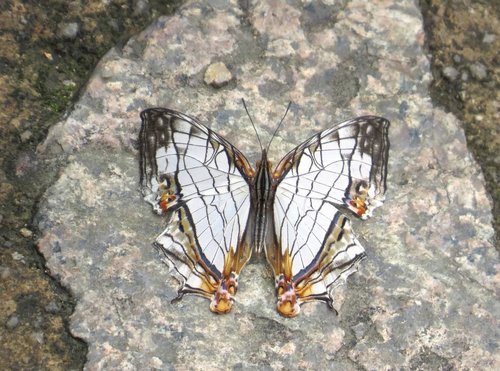
This species is Cyrestis thyodamas Boisduval, 1836. For both males and females, the upperside of the wings is white, though many specimens show pale ochraceous yellow, with black veins. On the forewing, there are four very slender, irregularly sinuous transverse black lines. The costal margin is shaded with ochraceous at the base and fuscous beyond it; the cell is crossed by an additional three or four short lines. In the interspaces, there is a very incomplete postdiscal series of broad fuscous rings with white centers; these rings are tinged with ochraceous near the tornus and are broadly interrupted in interspaces 3 and 4. Beyond this series, there are two transverse black lines that do not reach the dorsal margin, with fuscous shading between the lines. Both the apex and the termen are broadly shaded with fuscous. The hindwing has three fine transverse lines. There is a pair of postdiscal broad black lines with light sepia brown shading between them, forming a conspicuous band; the outer line of this pair is broken and incomplete. This band is followed by two irregular black lines, a more pronounced subterminal black line, and a narrow black terminal margin along the posterior edge. The dorsal margin is broadly fuscous at the base; the apical half, tornal area, and tornal lobe are rich ochraceous, marked with some sepia-brown and black patches. The underside of the wings is similar in pattern, with the upperside markings visible through transparency. The ochraceous shading on the dorsal margin and tornal area of the hindwing covers less area on the underside, but the tornal lobe is a darker ochraceous with a large, round black spot at its center. Markings on both the upper and undersides vary slightly in color depth and breadth. Many specimens have a diffuse fuscous spot between the pair of fine discal transverse lines on the forewing. Antennae, head, thorax, and abdomen are black above; the thorax and abdomen have lateral greyish longitudinal stripes, while the underside of the body is white. Females have paler body coloration than males. The race andamanica very closely resembles the typical form, but its dark markings are usually heavier and more pronounced. However, some specimens from the Anaimalai Hills closely match the lighter-colored Andaman individuals. One consistent distinguishing feature is the large amount of rich ochraceous color on the posterior portion of the hindwing upperside. The costal margin and the postdiscal series of rings on the forewing are also strongly tinged with ochraceous. This race appears to be common at Port Blair. The wing expanse of the species ranges from 58 to 70 mm. Distribution: The species is generally found across continental India, occurring in hills from the Himalayas to Travancore, and avoids the hot dry plains of northern and central India; it is also present in Assam, Manipur, Burma, Tenasserim, and the Kumaun Himalaya, with its range extending to China and Japan. A subspecies occurs on Taiwan.