About Cyptotrama asprata (Berk.) Redhead & Ginns
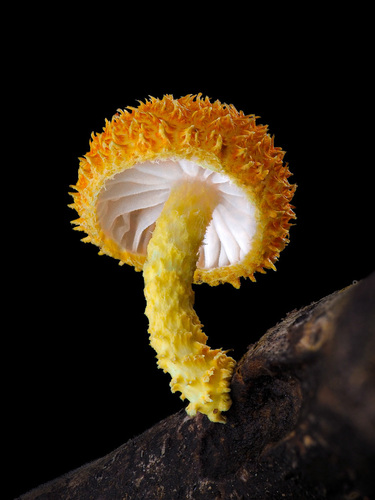
Cyptotrama asprata, scientifically named Cyptotrama asprata (Berk.) Redhead & Ginns, has a cap measuring 0.6 to 2.7 centimetres (0.2 to 1.1 in) in diameter, with a shape ranging from convex to cushion-shaped. The cap surface is dry. Young specimens are covered in characteristic spikes; as these spikes break up with age, the surface becomes more hairy or woolly in appearance. Older specimens usually have all their surface features worn away. When young, the cap margin is typically rolled inwards, and it gradually straightens as the mushroom reaches maturity. The cap is bright or pale yellow, with color intensity increasing toward the cap center. This species has a web-like ring that disappears quickly. The gills are pale yellow to white, are distantly spaced, and attach to the stem either adnate (squarely attached) or short decurrent (running a short way down the stem length). When dried and crushed, the gills feel greasy. The stem measures 1 to 6.7 cm (0.4 to 2.6 in) long, and 0.2 to 0.4 cm (0.1 to 0.2 in) thick at the apex; it is slightly thicker toward the base, and may be covered in woolly (flocculose) or hairy (fibrillose) hyphae. The stem surface can also be scaly, especially toward the base, or covered in very small granular particles. The mushroom’s flesh is white or pale yellow, with no distinctive taste or odor. It produces a white spore print, and is classified as inedible.
Cyptotrama asprata is a saprobic fungus that grows on decaying wood from both deciduous and coniferous trees. Documented host species include white fir (Abies concolor), sugar maple (Acer saccharum), other maple (Acer) species, grey alder (Alnus oblongifolia), beech (Fagus) species, spruce (Picea) species, ponderosa pine (Pinus ponderosa), other pine (Pinus) species, poplar (Populus) species, and oak (Quercus) species. In temperate North America, specimens are most commonly collected between July and September. This species has a pantropical distribution, and is widely found across tropical regions of the world. It has been collected in Australia, southeastern Canada, China, Costa Rica, India, Hawaii, New Zealand, Japan, and the Russian Far East. It is not found in Europe or northwestern North America.