About Cypripedium reginae Walter
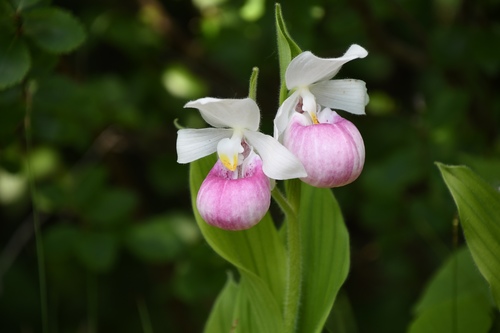
Cypripedium reginae Walter, also known as the showy lady's slipper, is a large terrestrial orchid in the subfamily Cypripedioideae. Like other lady's slipper orchids, it has flowers with a characteristic pouch-shaped labellum. It grows 21–100 cm (0.7–3 ft) in height, producing many stems from a single rootstock. Each stem bears three to five alternate, pubescent, ovately shaped leaves that can grow up to 25 cm (10 in) long and 16 cm (6 in) broad. Flowering stems produce one to three large, white and pink flowers. Its upper petals are white, reaching up to 4 cm (2 in) in length and 1.5 cm (0.59 in) across. The pouch-shaped labellum ranges from rose-pink to magenta, and measures 2.5–5.5 cm (0.98–2.17 in) in length. Although each seed pod produces a large number of seeds, this species reproduces largely by vegetative reproduction. Cypripedium reginae grows in wetland habitats including fens, wooded swamps, and riverbanks. It thrives in neutral to basic soils, but can also grow in slightly acidic conditions. Plants often form clumps via branching of their underground rhizomes. Its roots typically lie within a few inches of the soil surface. It prefers very loose soils, and when growing in fens it is most often found on mossy hummocks. It can tolerate full sun, but prefers partial shade for part of the day; when exposed to full sun, its flower lip becomes somewhat bleached and less deeply colored. It is occasionally eaten by white-tailed deer. This species is distributed in Canada from Saskatchewan east to Atlantic Canada, and in the United States from North Dakota east to the Atlantic coast and south to Arkansas and Tennessee. Cypripedium reginae reproduces both sexually and asexually. Sexual reproduction depends on pollination by insects such as syrphid flies, beetles, and Megachile bees. The flower's structure creates a tight space that pollinating insects must squeeze through. A pollinating insect first passes by the stigma, then rubs against the anther when exiting the floral trap. Pollination typically occurs in June; the seed pod (fruit) ripens by September and dehisces by October. Although a single seed pod can produce over 50,000 seeds, low germination rates and an 8-year period from seed to flowering make sexual reproduction inefficient. Asexual reproduction from rhizomes is a common way for populations to sustain themselves. This species flowers from early to midsummer, usually producing 1 to 2 flowers per stalk, and less commonly 3 or 4. The showy lady's slipper has been of horticultural interest for many years. Charles Darwin, like many before him, was unsuccessful in cultivating the plant. Its low seed germination rates and slow maturation to flowering make it vulnerable to illegal collection. Historically, it was difficult to raise from seed in sterile culture or greenhouse conditions, with germination taking many months in sterile culture. In the 1990s, a group of high school students in New Hampshire, led by Dr. Peter Faletra, made substantial progress in axenic culture from seed, achieving over 50% germination in approximately 3 weeks. Micropropagation efforts have had only marginal success. The New Hampshire Academy of Science has advanced methods for transplanting seedlings grown in axenic culture to artificial fens, which are available at their listed website. Multiple Cypripedium species, including this genus broadly, have been used in native remedies for dermatitis, toothaches, anxiety, and headaches, and also used as an antispasmodic, stimulant, and sedative. The preferred species for these uses are Cypripedium parviflorum and Cypripedium acaule, which are applied topically or consumed as tea.