About Cypripedium passerinum Richardson
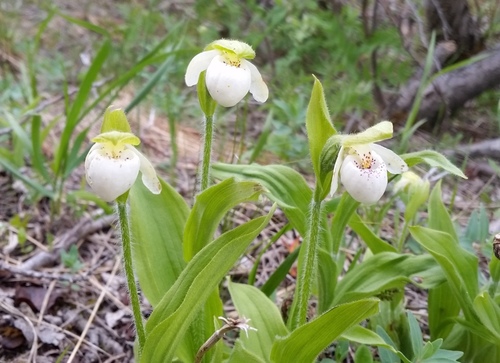
Cypripedium passerinum Richardson is a rhizomatous perennial herbaceous monocot in the orchid family, that reaches a maximum height of about 50 centimeters (20 inches). It produces 3 to 7 alternately arranged oval or lance-shaped leaves along its stem; each leaf can grow up to 19 centimeters (7.5 inches) long and 6 centimeters (2.4 inches) wide. All above-ground plant tissue is hairy and sticky. An inflorescence at the top of the stem holds one or two flowers. Each flower has one dorsal sepal that covers the petals, plus two lateral sepals. It has three petals total: two flat white petals positioned on either side, and a central petal modified into a white or pink-tinged pouch. The pouch has purplish spotting on its lip and inner surface, and this marking is said to resemble a sparrow's egg. The fruit produced by this orchid is a capsule. While the species can reproduce by seed, it more often reproduces vegetatively by growing new stems from its rhizome. This species grows farther north than any other member of the Cypripedium genus. Its typical habitats include moist low-elevation spruce forests, tundra, dunes, river terraces, lakeshores, and streambanks, and it often grows on calcareous substrates. It is commonly found growing alongside plant species such as white spruce (Picea glauca), Engelmann spruce (Picea engelmannii), western redcedar (Thuja occidentalis), red-osier dogwood (Cornus sericea), willows (Salix spp.), horsetail (Equisetum spp.), longtube twinflower (Linnaea borealis), sedges (Carex spp.), one-sided pyrola (Orthilia secunda), and moss carpet (Pleurozium schreberi). Cypripedium passerinum is native to northern North America. It is widespread across Canada, occurring from British Columbia to Quebec and in all three of Canada's northern territories. It is also found in Alaska, and in the Rocky Mountains of Montana, including within Glacier National Park.