About Cypripedium macranthos Sw.
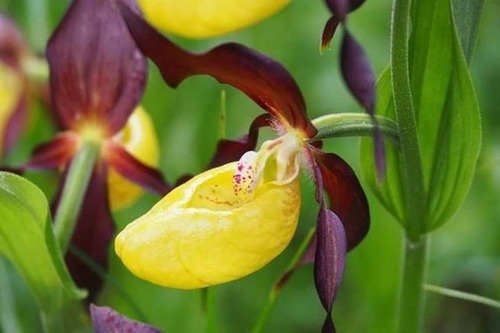
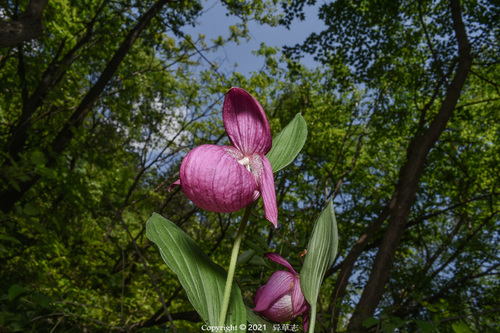
Cypripedium macranthos Sw. is a herbaceous plant that reaches heights of 25 to 50 cm (9.8 to 19.7 in). Its upright stem grows from a short, thick rhizome, with several sheaths located near the base of the stem. Each individual plant produces 3 to 4 leaves, which are elliptic or elliptic-lanceolate in shape, and measure 10–15 cm (3.9–5.9 in) long by 6–8 cm (2.4–3.1 in) wide. The inflorescence usually holds one flower, which is most commonly red, pink, or purple; it is rare for plants to produce two flowers, or for flowers to be white. The dorsal sepal is ovate-elliptic with a pointed tip, measuring 4–5 cm (1.6–2.0 in) long by 2.5–3 cm (0.98–1.18 in) wide. The synsepal is ovate with a slightly two-lobed tip, and measures 3–4 cm (1.2–1.6 in) long by 1.5–2 cm (0.59–0.79 in) wide. The petals are lanceolate, and each measures 4.5–6 cm (1.8–2.4 in) long by 1.5–2.5 cm (0.59–0.98 in) wide. The labellum measures 4.5–5.5 cm (1.8–2.2 in), is deeply pouched, and has a small opening 1.5 cm (0.59 in) across. The fruit is an ellipsoid capsule that is approximately 4 cm (1.6 in) long. C. macranthos is similar in appearance to Cypripedium tibeticum, which differs by having slightly larger, darker flowers. Cypripedium macranthos has a widespread distribution across Russia (including European Russia and Siberia), Kazakhstan, Mongolia (specifically in Huvsgul, Hentii, Mongol Daguur, and Khyangan), Japan, Korea, China (specifically in Hebei, Heilongjiang, Jilin, Liaoning, Nei Mongol, and Shandong provinces), and Taiwan. Unconfirmed reports place it also in Belarus and Ukraine. This species grows in a range of habitats from sea level up to 2,400 m (7,900 ft) above sea level, including meadows, forests, woodland edges, scrub, riparian areas, and grassy slopes. It prefers well-drained soil rich in humus, but can tolerate both acidic and alkaline substrates. While it grows best in slightly shaded areas, it can also survive in more open habitats. Cypripedium macranthos can reproduce both sexually and vegetatively. Its flowering period runs from June to July, and fruits develop from August to September. Its flowers are self-compatible, and are primarily pollinated by bumblebee queens. Cypripedium × ventricosum is a naturally occurring hybrid between C. macranthos and C. calceolus.