About Cypripedium candidum Muhl. ex Willd.
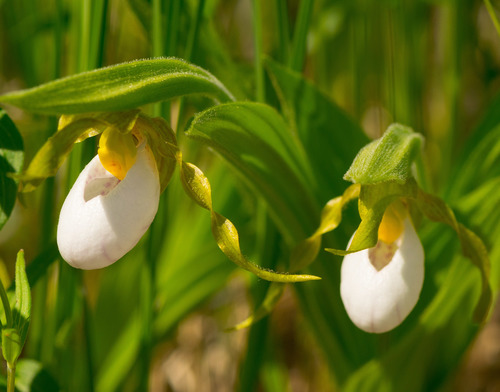
Cypripedium candidum Muhl. ex Willd. is one of the smallest species of Cypripedium native to North America, growing to a height of 20 to 36 cm (7.9 to 14.2 inches). This species blooms from late May to early June. It has a distinctive white pouch-like lip, which is sometimes dotted with maroon on the inside; this lip is accented by lateral sepals and petals that are tan, green, or brown. The leaves and stems of the plant are slightly pubescent, or covered in fine short hairs. Cypripedium candidum is a perennial plant that grows in generally long-lived clumps; some clumps can produce 50 or more flowers. It spreads via horizontal rhizomes with wiry roots that grow a few centimeters below the soil surface, which makes the plant resistant to most prairie fires. This species is known to naturally hybridize with the small yellow ladyslipper, C. parviflorum var. makasin, producing the hybrid Cypripedium × andrewsii. In terms of distribution, Cypripedium candidum ranges from western New York, across southern Ontario to North Dakota, and south to New Jersey and Missouri. Isolated populations of the species can be found in Connecticut, Maryland, Manitoba, Virginia, and Alabama; it was formerly found in Saskatchewan. This plant grows in alkaline wetlands and fens, and is often found in fragmented patches within rich, highly calcareous soils, along sedge meadow edges, and in calcareous ditches.